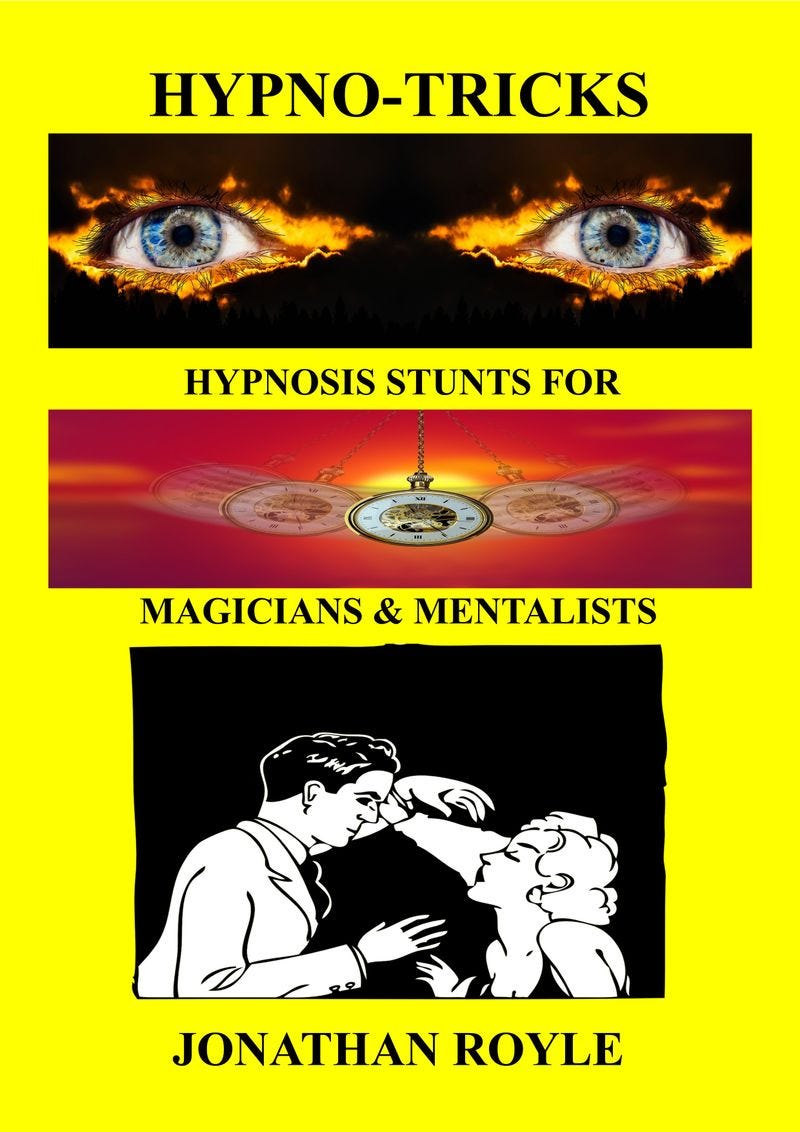
The Power of Hypno-Tricks and Relaxation in Hypnotherapy
How Physical Relaxation, Belief Convincers, Expectation and PURE SUGGESTION Can Enhance Therapeutic Change
By Dr Jonathan Royle — Creator of Complete Mind Therapy (CMT)

Introduction: Creating the Experience That Something Is Happening
As someone who has studied and practised hypnotherapy since 1989, I have long maintained that there’s no such thing as hypnosis — there is only PURE SUGGESTION.
By this, I mean that what people commonly recognise as hypnosis can largely be understood through the psychological principles of belief, expectancy, suggestion, imagination, emotional influence and the meaning that individuals attach to their experiences.
Two particularly valuable tools in this process are genuine physical relaxation and what I teach my students to call “Hypno-Tricks.”
Although these approaches may appear very different, they share one particularly important feature: both can give the client a powerful, personally convincing experience that something is happening during their hypnotherapy session.
And when a client experiences something that they believe demonstrates the effectiveness of the treatment, that experience can strengthen their expectation that further positive changes will follow.
The Genuine Power of Relaxation
I firmly believe that all hypnotherapists should read three particularly important books:
The Relaxation Response by Dr Herbert Benson.
Beyond the Relaxation Response by Dr Herbert Benson.
You Must Relax by Dr Edmund Jacobson.
These books help practitioners understand that relaxation is not simply an elaborate preliminary ritual designed to make somebody believe they are entering hypnosis.
Relaxation can produce genuine physiological and psychological benefits in its own right.
Edmund Jacobson’s pioneering work on Progressive Muscular Relaxation demonstrated the practical value of systematically tensing and releasing different muscle groups to develop awareness of muscular tension and encourage physical relaxation.
Herbert Benson subsequently helped popularise the Relaxation Response, describing how relaxation practices can counter aspects of the body’s stress response.
In today’s increasingly busy world, many people rarely give themselves permission to relax properly.
They may spend much of their day feeling rushed, worried, overstimulated, physically tense or emotionally overwhelmed.
For some clients, simply spending twenty or thirty minutes in a safe, comfortable environment, with their eyes closed, listening to a reassuring voice while systematically relaxing their body, can be a profoundly welcome experience.
Their breathing may become slower.
Their muscles may release tension.
They may feel calmer, more comfortable and less preoccupied with everyday worries.
These are genuine experiences, not imaginary effects produced by hypnosis.
Relaxation practices have evidence supporting benefits for stress, anxiety and some physiological measures, although outcomes vary between individuals and relaxation is not a cure for every condition.
Relaxation as a Powerful Placebo Trigger
Here is where things become particularly interesting.
Imagine a client arriving for hypnotherapy feeling stressed, anxious and physically tense.
Following a carefully delivered progressive muscular relaxation exercise, they begin to experience a genuine change in their physical and emotional state.
They feel noticeably calmer.
Their shoulders have relaxed.
Their breathing feels easier.
They may experience a sense of comfort they have not felt for some considerable time.
Now consider how they might interpret that experience.
They came expecting hypnosis to produce a noticeable change.
And something noticeable has indeed happened.
They may therefore conclude:
“Wow! This hypnosis really is working. I can actually feel the difference already!”
That interpretation can become an extremely powerful positive placebo trigger and belief convincer.
The relaxation is genuine, but the client may attribute the experience to the supposedly special power of hypnosis.
This can increase their confidence in the therapist and their expectations concerning the remainder of the session.
In other words, progressive muscular relaxation can offer two potentially valuable benefits simultaneously.
Firstly, the client experiences real physical and psychological relaxation.
Secondly, that experience may reinforce their belief that the therapeutic process is effective, increasing positive expectations for subsequent suggestions.
The first benefit does not depend upon placebo. The second involves the possible additional contribution of meaning, expectancy and treatment context.
This is one reason why I believe progressive muscular relaxation deserves a prominent place in every hypnotherapist’s training, even though it need not be used in every session.
Hypno-Tricks: The Power of a Convincing Experience
Another approach I teach within my Elite Hypnotherapy, Stage Hypnotism & NLP Hypnosis Bootcamp involves what I call Hypno-Tricks.
These are simple physical demonstrations, sometimes described as body tricks or suggestibility convincers, which exploit ordinary principles of biomechanics, muscular positioning, attention or perception.
When performed under appropriate conditions, some can produce surprisingly convincing effects.
For example, a participant might experience difficulty opening their eyes after adopting a particular muscular position, or difficulty separating their hands during a hand-lock demonstration.
To the participant, the experience may appear extraordinary.
They are trying to perform an apparently simple action, yet find it unexpectedly difficult.
Now imagine that the hypnotist has introduced the demonstration using suggestions such as:
“Imagine your hands becoming more and more firmly locked together, as though they have become one solid unit.”
When the participant subsequently experiences difficulty separating their hands, they may conclude that the hypnotist’s suggestions caused the effect.
Yet, in certain demonstrations, the physical positioning and muscular mechanics already make the outcome highly likely, regardless of whether the participant has entered any special hypnotic state.
This distinction is fundamental.
The physical effect may arise from ordinary bodily mechanisms, while the psychological significance comes from what the participant believes caused it.
Not every demonstration is guaranteed to work for every person, and the mechanisms differ between techniques. Nevertheless, well-chosen physical demonstrations can be reliable enough to produce compelling experiences under suitable conditions.
The Belief Convincer: From One Successful Experience to the Next Suggestion
The real significance of a Hypno-Trick is not necessarily the trick itself.
It is what the participant comes to believe afterwards.
Before the demonstration, they may have been uncertain whether hypnosis works.
Afterwards, they may be thinking:
“I imagined my hands locking together, just as the hypnotist suggested, and then I couldn’t separate them!”
From their perspective, they have just experienced evidence that the hypnotist can suggest something and that suggestion can become their reality.
This may create an important shift in expectancy.
If the hypnotist’s words apparently made their hands lock together, perhaps the same person’s suggestions can help them become more confident, overcome an unwanted habit or feel differently about a particular situation.
One convincing experience may therefore increase their willingness to engage with further suggestions.
This is closely related to the psychological principles of response expectancy, social influence, perceived authority and placebo effects.
It also illustrates why the context surrounding a demonstration can be as important as the physical phenomenon itself.
Does the Critical Faculty Go for a Metaphorical Tea Break?
I sometimes describe this process to my students by suggesting that the client’s critical faculty, analytical mind or executive function has gone for a metaphorical tea break.
It is a deliberately humorous description, but it illustrates an important idea.
The participant has experienced something that appears to confirm the hypnotist’s authority and the power of suggestion.
As a result, they may temporarily become less inclined to question subsequent suggestions and more willing to imagine that those suggestions can influence their experience.
They may stop analysing every instruction and instead become more absorbed in the process.
This does not mean that the brain’s executive functions have literally switched off.
Nor does it mean that the client has lost free will, become incapable of critical thinking or must automatically accept whatever the hypnotist says.
There is no established scientific evidence that a Hypno-Trick disables a specific mental faculty or creates unrestricted access to the unconscious mind.
However, the metaphorical tea-break explanation can be a useful teaching analogy for a change in attitude.
The participant moves from scepticism towards expectation.
From questioning whether anything will happen towards anticipating that something will happen.
And from merely listening to suggestions towards actively imagining and responding to them.
That change in belief and expectation is potentially far more important than the original hand-lock or eye-lock demonstration.
Combining Hypno-Tricks With Progressive Muscular Relaxation
This is where I believe the two approaches can complement one another particularly effectively.
Imagine beginning a hypnotherapy session with a simple, safe physical demonstration.
The client experiences their hands becoming unusually difficult to separate.
They may interpret this as evidence that they are responding powerfully to the hypnotist’s suggestions.
Their expectations increase.
The therapist then guides them through a progressive muscular relaxation exercise.
The client now experiences a second, entirely genuine change: their body becomes more relaxed and their mind may feel calmer.
From their perspective, they have experienced two convincing demonstrations that something is happening.
Firstly, an apparently extraordinary response to suggestion.
Secondly, a noticeable change in their physical and emotional state.
The client may now be considerably more receptive to the therapeutic suggestions that follow.
This creates what I consider a particularly useful combination of physical experience, psychological expectation, positive emotion and perceived therapeutic credibility.
The hypnotist can then use appropriate suggestions and visualisations to help the client imagine themselves making the changes they wish to achieve.
However, there is an important ethical distinction between allowing an experience to strengthen confidence and deliberately misrepresenting a mechanical effect as proof of special hypnotic powers.
In my view, these demonstrations are most defensible when used transparently as illustrations of how expectations, attention and bodily responses interact. Their purpose should be to increase the client’s confidence in their own capabilities, rather than establish unquestioning obedience to the therapist.
The Importance of Giving Clients Permission to Relax and Change
There is another factor that I believe deserves attention.
Many clients spend their lives attending to everybody else’s needs.
They are busy working, worrying, caring for others, dealing with responsibilities and responding to the pressures of everyday life.
They rarely stop.
They rarely give themselves permission to relax.
And they may have become so accustomed to physical tension that they barely notice it.
A hypnotherapy session can provide a rare opportunity to feel cared for, valued, supported and safe.
This connects directly with the Seven Positive Pillars of my Complete Mind Therapy approach:
Loved, Wanted, Needed, Appreciated, Cared For, Cherished and Valued.
A client who feels genuinely listened to and respected may already begin experiencing something psychologically beneficial before any formal hypnotic suggestions are delivered.
When that positive interpersonal experience is combined with genuine relaxation, encouraging suggestions and greater confidence in their ability to change, the overall treatment experience can become more meaningful.
Conclusion: The Experience Creates the Expectation
The central message is that a successful hypnotherapy session need not depend upon a mysterious trance state.
The client can experience real physical relaxation.
They can experience surprising bodily phenomena.
They can develop greater confidence in the therapist.
They can begin expecting positive changes.
And those expectations may influence how they respond to subsequent suggestions.
A Hypno-Trick can create a convincing experience. Progressive Muscular Relaxation can create a genuinely beneficial physical experience. Together, they can strengthen the psychological context in which therapeutic suggestions are received.
This does not guarantee that subsequent suggestions will work, nor does it prove that hypnosis operates exclusively through placebo. But it offers a useful practical illustration of how belief, expectation, physiological change and suggestion may interact.
For that reason, I encourage hypnotherapists to study the work of Edmund Jacobson and Herbert Benson, alongside the psychological research into suggestion, response expectancy and placebo effects.
Because ultimately, the therapist’s greatest contribution may not be putting someone into hypnosis.
It may be helping them experience something that convinces them they are capable of changing.
And that brings us back to my central philosophy:
THERE’S NO SUCH THING AS HYPNOSIS — THERE IS ONLY PURE SUGGESTION.
References and Recommended Reading
Benson, H. (1975). The Relaxation Response. William Morrow. A foundational exploration of the physiological and psychological effects of relaxation practices.
Benson, H. (1984). Beyond the Relaxation Response. Times Books. Explores how personal beliefs and meaning may interact with relaxation practices.
Jacobson, E. (1934). You Must Relax. McGraw-Hill. A foundational practical text on muscular relaxation and the relationship between physical tension and psychological states.
Kirsch, I. (1994). Clinical Hypnosis as a Nondeceptive Placebo: Empirically Derived Techniques. American Journal of Clinical Hypnosis, 37(2), 95–106. Read the paper.
Kirsch, I. (1999). Hypnosis and Placebos: Response Expectancy as a Mediator of Suggestion Effects. Anales de Psicología, 15(1), 99–110. Read the paper.
Kirsch, I. (1997). Suggestibility or Hypnosis: What Do Our Scales Really Measure? International Journal of Clinical and Experimental Hypnosis, 45(3), 212–225. Read the paper.
Muhammad, M. K., et al. (2024). Efficacy of Progressive Muscle Relaxation in Adults for Stress, Anxiety, and Depression: A Systematic Review. Read the full review.
Royle, J. (2015). The Key’s to Hypnotic Success. International Journal of Complementary & Alternative Medicine. Read Jonathan Royle’s original MedCrave publication.
Jonathan Royle — Creator of Complete Mind Therapy (CMT), hypnotherapy practitioner and trainer since 1989.
This article presents the author’s practical philosophy alongside relevant psychological research. Hypno-Tricks and their proposed effects on subsequent therapeutic responsiveness have not been established as universally reliable clinical interventions.
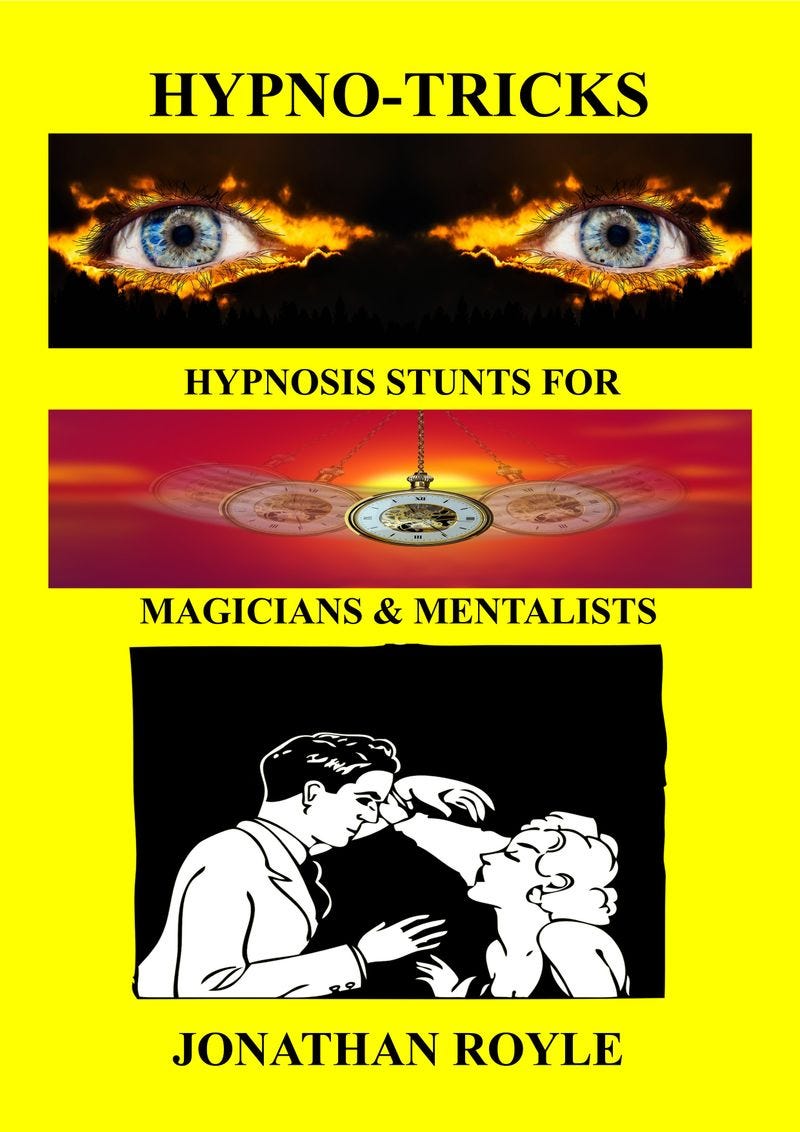
My book “Hypno-Tricks” is available as a PDF here:
https://jonathanroyle.sellfy.store/p/hypno-tricks-hypnosis-stunts-for-magicians-and-mentalists/
Or as a Real paperback book from Amazon here:
https://www.amazon.co.uk/HYPNO-TRICKS-Hypnosis-Stunts-Magicians-Mentalists/dp/B0BN21JHF1/
Hypno-Tricks galore along with the true power of the Relaxation Response are taught within the “Elite Hypnotherapy, Stage Hypnosis & NLP Hypnotism” Bootcamp members area.
NOTE = You can get 50% off Lifetime Membership to the Bootcamp where you will also gain access to another 30+ Professional Qualifications along with business building & profit producing tools galore by entering the discount voucher code of WIZARD when using the checkout to secure your membership here
https://www.magicalguru.com/elite-hypnotherapy-nlp-hypnosis-stage-hypnotism-bootcamp/
There's No Such Thing as Hypnosis — There Is Only PURE SUGGESTION in Hypnotherapy

There’s No Such Thing as Hypnosis — There Is Only PURE SUGGESTION in Hypnotherapy