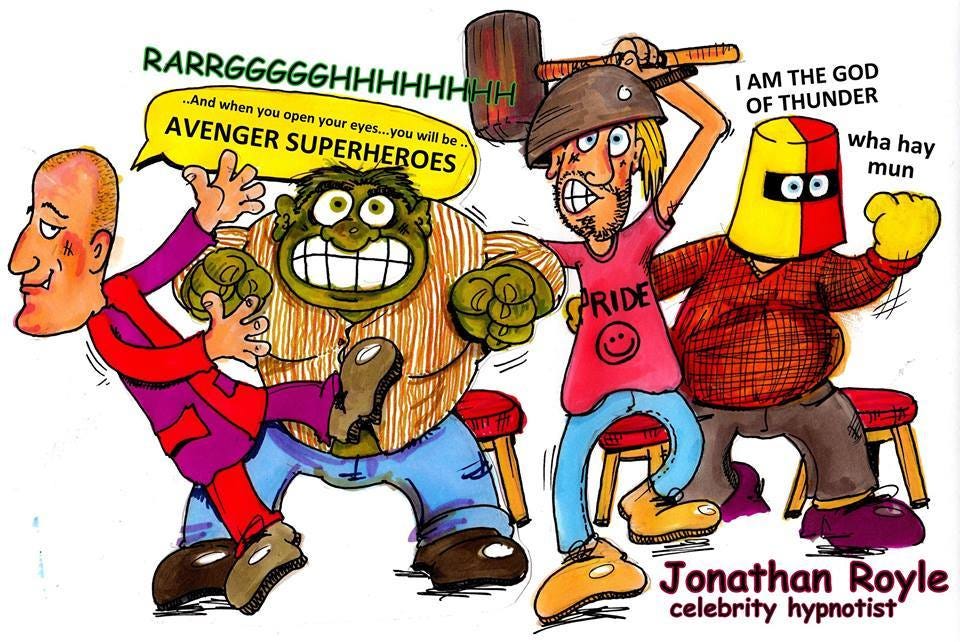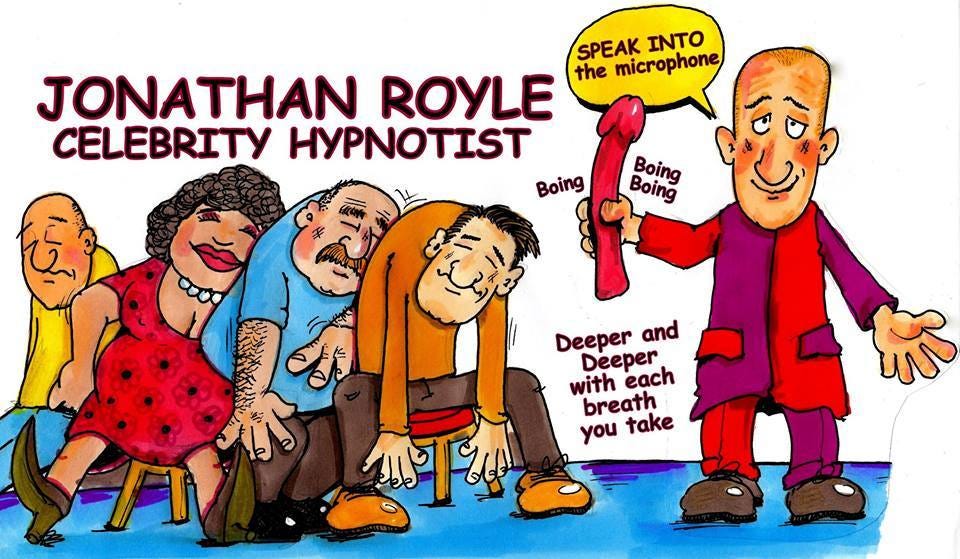
Belief, Expectation, Compliance, Social Psychology and the Psychology of Having Your 15 Minutes of Fame
By Dr Jonathan Royle — Professional Comedy Stage Hypnotist since 1990 and Creator of Complete Mind Therapy
Introduction: Stage Hypnosis Is Mental Karaoke!
Having performed professionally as a comedy stage hypnotist since 1990, and having trained what I believe may be more of today’s successful working comedy stage hypnotists than almost any other living hypnosis trainer, I have reached a very definite conclusion:
THERE’S NO SUCH THING AS HYPNOSIS — IT’S ALL JUST PURE SUGGESTION!
Or, to express it another way:
HYPNOSIS EXISTS ONLY IN THE MIND OF THE BELIEVER!
Now, before anyone misunderstands me, I am not suggesting that stage hypnosis shows are necessarily filled with people deliberately pretending to be hypnotised.
Far from it!
Many volunteers genuinely believe they have experienced something extraordinary. Some become convinced they entered a special state of trance, while others sincerely believe that the hypnotist’s words temporarily controlled their behaviour.
What I am suggesting is that these experiences can be understood through a fascinating combination of belief, expectation, social influence, imagination, compliance, perceived authority and the perfectly natural human desire to feel important, appreciated and valued.
And when you really understand these principles, you begin to realise that a successful comedy stage hypnosis show has a great deal in common with something else that audiences have enjoyed for years.
KARAOKE!
Except that instead of getting up on stage to sing their favourite song, volunteers get up to become the stars of an extraordinary comedy performance.
I call it MENTAL KARAOKE!
The Perfect Environment to Let Your Hair Down
Think about what happens at a comedy stage hypnosis show.
Members of the audience have come along expecting to be entertained.
They have probably seen advertisements promising an amazing hypnotist who can apparently make ordinary people do extraordinary things.
They are excited, curious and perhaps a little nervous.
Some have already decided they would love to volunteer.
Others may initially be reluctant, but gradually become more enthusiastic as the atmosphere develops.
The lights, music, applause, laughter and personality of the performer all contribute to the occasion.
Then volunteers are invited onto the stage.
Suddenly, ordinary members of the public become the centre of attention.
Hundreds of people may be watching them.
Their friends are cheering.
The audience is laughing.
They are being encouraged to behave in ways they would probably never normally consider doing in everyday circumstances.
And here is the important point:
The stage hypnotist has created an environment in which people have permission to let their hair down, enjoy themselves and experience their own 15 minutes of fame.
They can feel special.
They can feel wanted.
They can feel appreciated.
They can feel valued.
And when the audience responds enthusiastically, they may even feel loved.
This connects directly with the Seven Positive Pillars I teach within my Complete Mind Therapy approach:
Loved — Wanted — Needed — Appreciated — Cared For — Cherished — Valued.
I believe that the emotional rewards of participation are among the most important, yet frequently overlooked, ingredients of successful comedy stage hypnosis.
The Perfect Excuse: “The Hypnotist Made Me Do It!”
Here is where the psychology becomes particularly interesting.
In everyday life, many people are restrained by concerns about embarrassment, social judgement and what others might think of them.
They may secretly enjoy the idea of dancing ridiculously, pretending to be a famous celebrity, singing loudly or performing some absurd comedy routine.
But they hesitate.
What if they look foolish?
What if their friends laugh at them?
What if somebody asks why they behaved like that?
Stage hypnosis offers a wonderfully convenient answer.
“THE HYPNOTIST MADE ME DO IT!”
Suddenly, the participant has a socially acceptable explanation for behaving in ways they might otherwise feel embarrassed about.
They can enjoy the attention without feeling entirely responsible for the performance.
They can be outrageous, silly, dramatic and entertaining while maintaining the belief that the hypnotist was responsible.
This is what I consider one of the most powerful aspects of the stage hypnosis experience.
The hypnotist creates a context in which people can temporarily step outside their usual social identity.
They are given permission to perform.
And, afterwards, they have a ready-made explanation for what happened.
Importantly, this does not mean volunteers actually lose responsibility or control. It means the social explanation of being hypnotised may reduce feelings of embarrassment and make unusual behaviour easier to accept.
Two Ways Volunteers Keep Their 15 Minutes of Fame Going
Over many years of performing, I have noticed two particularly interesting ways volunteers sometimes describe their experiences after a show.
The first group say they cannot remember what happened.
They may tell their friends:
“I honestly don’t remember doing any of that!”
Their friends then excitedly explain what happened.
“You were absolutely hilarious!”
“You thought you were a famous singer!”
“You had the whole audience in stitches!”
And so the volunteer remains the centre of attention even after the performance has finished.
Their friends recount the highlights, describe their behaviour and reinforce the idea that something extraordinary happened.
In some cases, the volunteer may genuinely experience gaps in recall or develop a strong belief that they cannot remember particular events.
In other cases, expectations about hypnotic amnesia or the social circumstances may influence how they describe their memories.
The second group say they remember everything, but couldn’t stop themselves.
They may explain:
“I knew exactly what I was doing, but I just couldn’t help myself!”
Or:
“I could hear everything the hypnotist was saying, but when he told me to do something, I just did it!”
Once again, they receive attention.
Friends ask questions.
People express amazement.
And the participant’s account becomes part of the entertainment.
I am not suggesting that everybody consciously invents these explanations to gain attention.
Many sincerely believe what they are reporting.
But both accounts fit neatly within the cultural expectations surrounding hypnosis.
One person interprets the experience as amnesia.
Another interprets it as involuntary obedience.
And both may interpret their participation as evidence that they were genuinely hypnotised.
Hypno-Tricks: Making Belief Feel Like Reality
One of the most important elements I teach within my Elite Hypnotherapy, Stage Hypnotism & NLP Hypnosis Bootcamp is the use of what I call Hypno-Tricks.
These are physical demonstrations designed to give volunteers an immediate, convincing experience of something unusual happening.
Examples include demonstrations involving apparently locked hands, apparently locked eyelids or other seemingly involuntary physical responses.
Some of these effects can be produced or strongly encouraged by ordinary principles of body positioning, muscular mechanics, attention and expectation.
The volunteer experiences something surprising.
Perhaps they find it unexpectedly difficult to separate their hands.
Perhaps their eyelids feel unusually heavy or difficult to open.
The hypnotist has been giving them suggestions to imagine exactly that happening.
So what conclusion might they reach?
“I imagined what the hypnotist told me to imagine, and then it actually happened!”
That experience can become a powerful belief convincer.
Before the demonstration, the volunteer might have been wondering whether hypnosis was real.
Afterwards, they may feel they have personally experienced proof that the hypnotist’s words can influence their body.
They may now expect subsequent suggestions to be equally effective.
This is an example of how an actual physical experience can acquire a particular psychological meaning.
The sensation is real.
The interpretation is shaped by expectation and context.
Some demonstrations are highly reliable under suitable conditions, but no physical trick should be assumed to work without exception on every individual. Nor should an ordinary biomechanical effect be falsely represented as proof that the volunteer has surrendered control of their mind.
The real value lies in understanding how attention, imagination, bodily responses and expectation can interact.
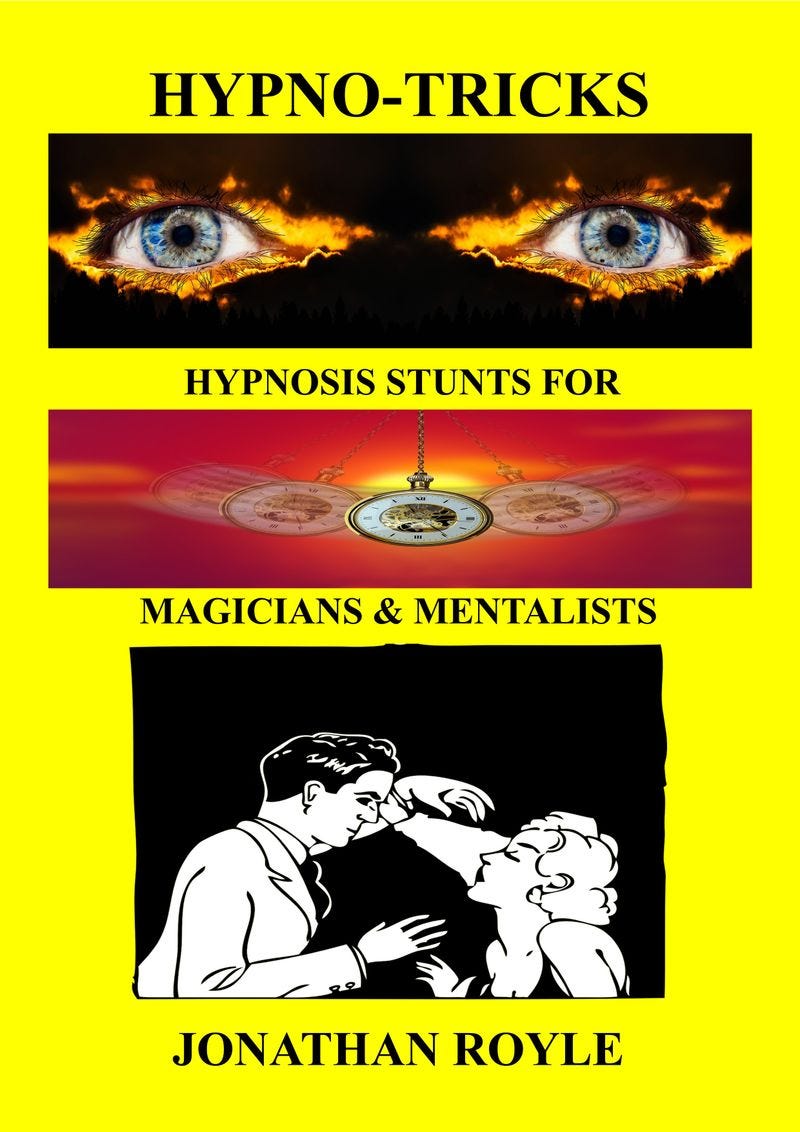
My book “Hypno-Tricks” is available as a PDF here:
https://jonathanroyle.sellfy.store/p/hypno-tricks-hypnosis-stunts-for-magicians-and-mentalists/
Or as a Real paperback book from Amazon here:
https://www.amazon.co.uk/HYPNO-TRICKS-Hypnosis-Stunts-Magicians-Mentalists/dp/B0BN21JHF1/
When the Critical Faculty Goes for a Metaphorical Tea Break
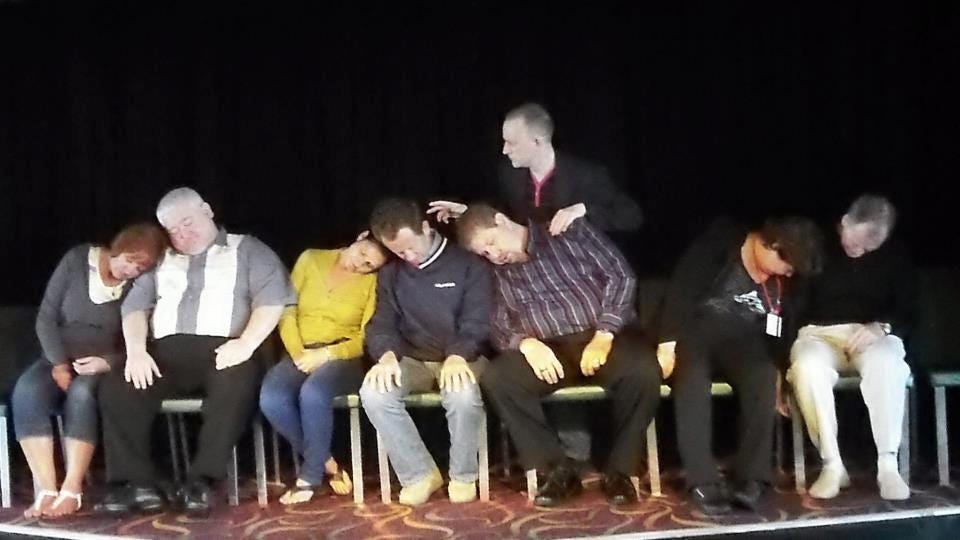
I often describe the next stage by saying that the volunteer’s critical faculty, analytical mind or executive function has gone for a metaphorical tea break.
They have experienced something they interpret as evidence of the hypnotist’s power.
They have heard the hypnotist suggest that something would happen.
Something apparently happened.
And now they expect the hypnotist’s next suggestions to become reality as well.
In my teaching, I sometimes compare this to a soldier on parade who has learned to respond automatically to commands from an authority figure.
The soldier hears a command and responds without spending time consciously analysing every instruction.
Similarly, a highly engaged stage hypnosis volunteer may become increasingly willing to respond quickly and spontaneously to the performer’s suggestions.
However, this is an analogy, not evidence that hypnosis disables executive functioning or produces unquestioning obedience.
Volunteers can retain awareness, judgement and the ability to refuse instructions.
What may change is their expectation, willingness to participate, absorption in the performance and sense of how voluntary their actions feel.
In my view, this is one of the central secrets of successful stage hypnotism.
The volunteer increasingly believes that responding to the hypnotist’s suggestions is what they are supposed to experience — and that expectation can influence what they subsequently do.

The Hypnotist’s Persona: Act Like It Will Work!
Long before a volunteer steps onto the stage, their expectations may already have been influenced.
The promotional posters.
The advertising.
The reputation of the hypnotist.
The stories told by previous audience members.
The impressive introduction.
The music.
The lighting.
The performer’s confidence, charm and charisma.
All these things help create a particular expectation.
The audience has come to see a hypnotist.
They expect hypnotic phenomena.
They expect volunteers to behave in extraordinary ways.
And the hypnotist presents the entire experience as something that is going to happen.
I frequently tell my students:
“Act like the hypnotist. Act like it will work. And people are more likely to believe it will work for them!”
A confident performer can establish a powerful atmosphere of expectation.
The volunteers may become more willing to participate because they believe they are in the hands of someone who knows exactly what they are doing.
This relates to the Pygmalion Effect, the Halo Effect, social influence and response expectancy.
The performer’s confidence does not guarantee success, but it can contribute to the credibility of the experience.
And in stage hypnotism, credibility and expectation are enormously important.
Graham Wagstaff: Hypnosis, Compliance and Belief
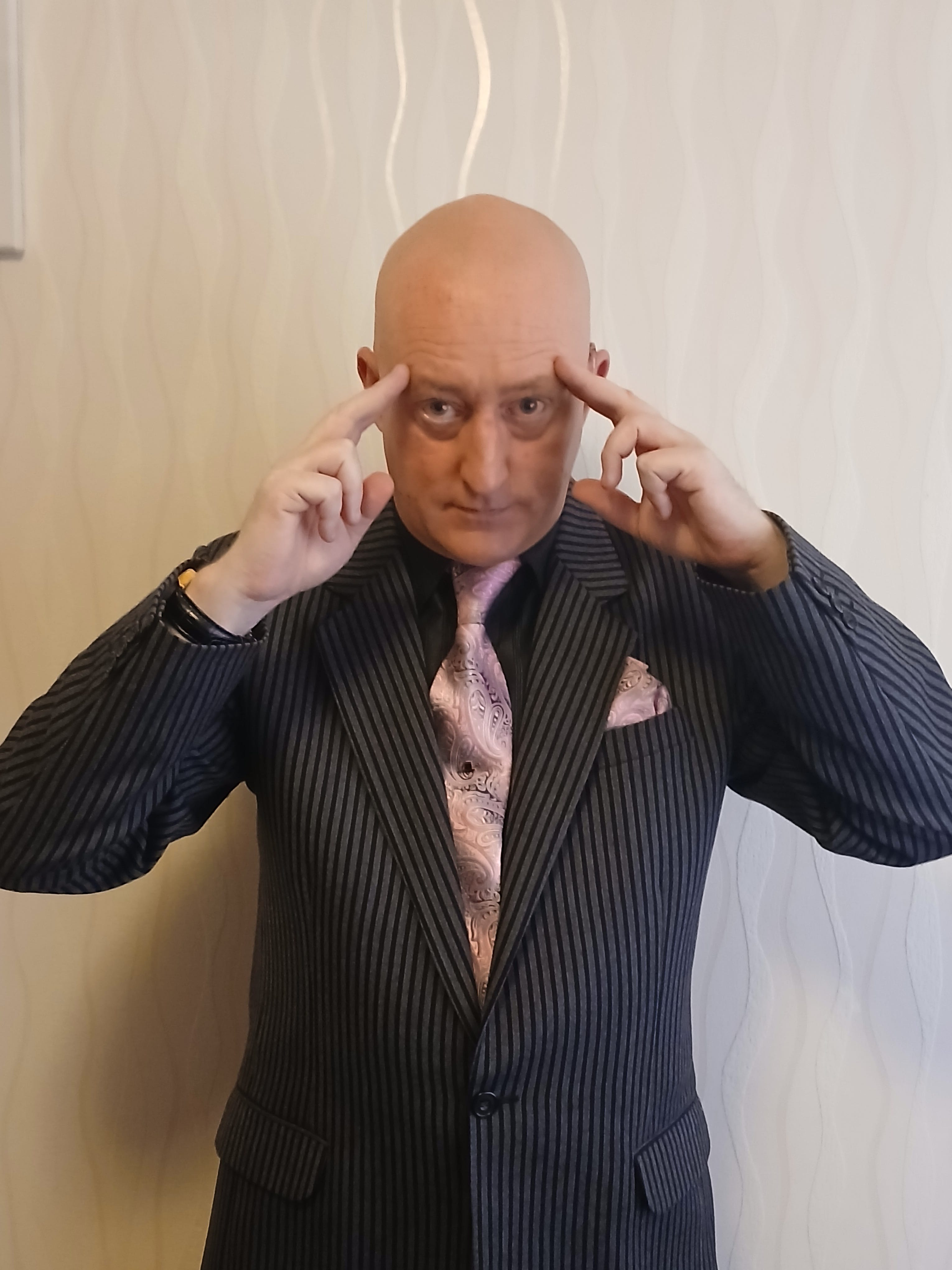
One of the researchers whose work I believe every serious stage hypnotist should study is Professor Graham F. Wagstaff of the University of Liverpool.
His influential 1981 book, Hypnosis, Compliance and Belief, is particularly relevant to my philosophy.
Wagstaff examined hypnosis through the lens of ordinary psychological processes, including compliance, belief, social influence and the way people interpret their experiences.
Rather than assuming that all hypnotic phenomena require a special trance state, his work investigated whether they could be explained through familiar human psychological processes.
This is precisely the direction in which I believe stage hypnotists should be looking.
We do not necessarily need a mysterious altered state to explain extraordinary-looking behaviour.
We need to understand the people involved, the expectations they bring with them, the social circumstances and the suggestions they receive.
Wagstaff’s 1997 paper, What Is Hypnosis?, provides particularly strong support for this position.
He discusses how phenomena traditionally attributed to hypnosis can often be produced in people who have not undergone hypnotic induction, provided they are appropriately motivated and instructed.
His explanation includes role enactment, imagination, relaxation, compliance, obedience, attention, distraction, attitudes and expectations.
This is remarkably consistent with my belief that stage hypnosis involves ordinary psychological processes operating within an extraordinary entertainment environment.
The Scientific Evidence Behind the Mental Karaoke Theory
Several further studies are particularly relevant.
1. Compliance and Post-Hypnotic Amnesia
In a 1977 experiment, Wagstaff investigated whether apparent post-hypnotic amnesia could be influenced by compliance.
Participants who were given an opportunity to acknowledge compliant behaviour before the memory test showed substantially less apparent amnesia than participants who received that opportunity afterwards.
This provides experimental evidence that compliance can influence reports of hypnotic amnesia.
It is particularly relevant to the volunteers who emerge from a stage hypnosis show claiming they cannot remember what happened.
However, the findings do not establish that all hypnotic amnesia is deliberate pretence or attention-seeking.
2. Expectation Can Influence Subsequent Hypnotic Responses
Research by Council, Kirsch and Hafner in 1986 found that expectations following hypnotic induction predicted subsequent responsiveness to suggestions.
This supports the idea that an induction or preliminary demonstration can influence what participants expect to experience next.
In my terms, a successful belief convincer may help prepare the volunteer psychologically for further suggestions.
3. Belief and Response Can Reinforce One Another
Research published in 2006, Expect the Unexpected: Ability, Attitude, and Responsiveness to Hypnosis, examined the relationship between expectancy and hypnotic responding.
It found evidence that expectations influenced subsequent responses, while responses themselves influenced later expectations.
This is especially relevant to Hypno-Tricks.
A participant expects something to happen.
They experience a response.
That experience increases their expectation of further responses.
And the process may reinforce itself as the session progresses.
4. Socio-cognitive Theories of Hypnosis
A 2024 systematic review, How Hypnotic Suggestions Work, examined major theoretical explanations of hypnosis, including Wagstaff’s compliance-and-belief approach.
The review explains how socio-cognitive theories seek to understand hypnotic phenomena through everyday psychological mechanisms such as expectation, imagination, social context and compliance.
However, it also discusses evidence that expectancy alone is insufficient to explain all hypnotic responses.
That distinction matters.
The research supports my argument that stage hypnosis can be understood through ordinary psychological processes, but it does not establish that every participant is merely complying or that every experience is caused solely by belief.
Stage Hypnosis Is Not Necessarily Pretending
I want to emphasise this point because it is frequently misunderstood.
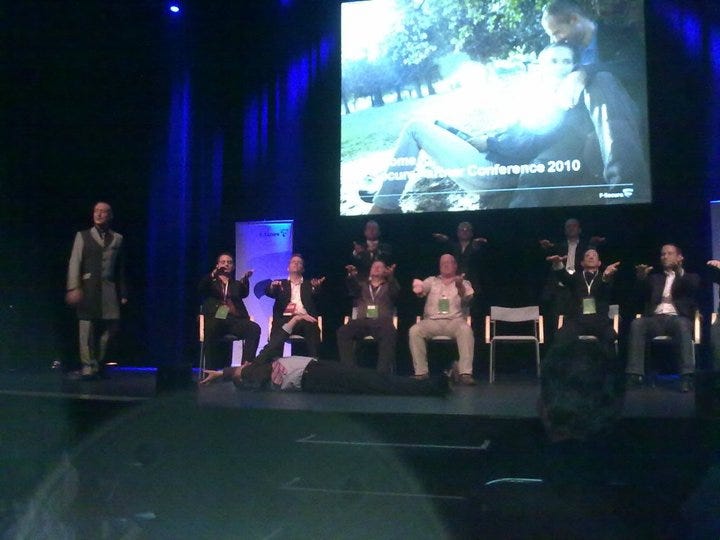
When I say that stage hypnosis is mental karaoke, I am not saying every volunteer is consciously acting.
A volunteer may genuinely experience an action as involuntary.
They may genuinely feel their hands are stuck together.
They may sincerely experience unusual sensations or changes in perception.
They may genuinely believe they were in a special state of trance.
The distinction is between having a genuine experience and correctly identifying what caused that experience.
A person can sincerely experience something while interpreting it through the expectations they have developed about hypnosis.
And the social environment of a stage show can strongly influence those expectations.
Why the Audience Is Part of the Hypnosis
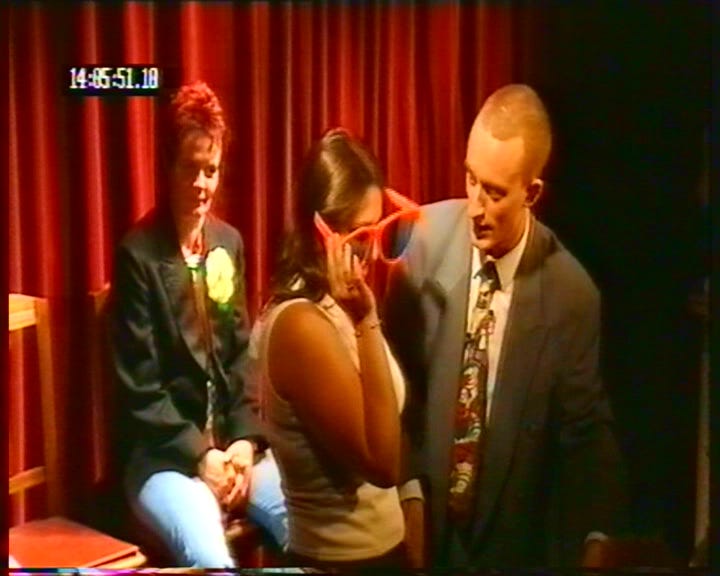
One aspect of comedy stage hypnosis that I believe deserves much greater recognition is the role of the audience.
The audience is not simply watching the performance.
It is helping create the psychological environment in which the performance takes place.
Every burst of laughter rewards the volunteer’s behaviour.
Every round of applause reinforces the feeling of being appreciated.
Every cheer communicates approval.
Every enthusiastic reaction makes the volunteer feel that they are contributing to something enjoyable.
For some people, this may be the most attention they have received in years.
They are the stars of the show!
And because they believe they are hypnotised, they have a convenient explanation for behaving in ways they might ordinarily avoid.
This is why I consider comedy stage hypnosis to be a particularly fascinating example of social psychology in action.
It combines suggestion, imagination, expectancy, perceived authority, audience feedback, social permission and the emotional rewards of participation.
In that respect, mental karaoke is more than a humorous description.
It is a useful analogy for understanding why people may enthusiastically participate in unusual public performances.
Karaoke singers do not require a special altered state to perform.
They require an opportunity, a supportive atmosphere, sufficient confidence and permission to enjoy themselves.
My argument is that stage hypnosis may work through many of the same principles, with the additional influence of suggestions and culturally established beliefs about hypnosis.
Conclusion: The Real Secret of Comedy Stage Hypnosis
After performing comedy stage hypnosis shows since 1990, I remain convinced that the most important skill a successful stage hypnotist can develop is not the ability to induce some mysterious trance state.
It is the ability to create the right psychological environment.
An environment where volunteers feel comfortable.
Where they feel special.
Where they believe something extraordinary is possible.
Where they experience convincing responses to suggestion.
Where they can enjoy being the centre of attention.
Where the audience’s enthusiasm reinforces their participation.
And where they have permission to behave in entertaining ways without feeling embarrassed about doing so.
The hypnotist’s confidence, charisma, presentation and suggestions all contribute to that environment.
But the volunteers themselves remain active participants in creating the performance.
For me, that is the real secret of successful comedy stage hypnosis.
Not mysterious mind control.
Not supernatural powers.
Not necessarily a unique state of consciousness.
But the extraordinary potential of ordinary psychological processes when combined with entertainment, expectation, imagination and social permission.
STAGE HYPNOSIS IS MENTAL KARAOKE!
And that is why I maintain:
THERE’S NO SUCH THING AS HYPNOSIS — THERE IS ONLY PURE SUGGESTION!
HYPNOSIS EXISTS ONLY IN THE MIND OF THE BELIEVER!
References and Recommended Reading
Wagstaff, G. F. (1981). Hypnosis, Compliance and Belief. Harvester Press. Bibliographic record and academic review.
Wagstaff, G. F. (1977). An Experimental Study of Compliance and Post-Hypnotic Amnesia. British Journal of Social and Clinical Psychology, 16(3), 225–228. Read the research abstract.
Wagstaff, G. F. (1997). What Is Hypnosis? Interdisciplinary Science Reviews, 22(2), 155–163. Read the paper.
Wagstaff, G. F. (1998). The Semantics and Physiology of Hypnosis as an Altered State: Towards a Definition of Hypnosis. Contemporary Hypnosis, 15(3), 149–165. Read the paper.
Wagstaff, G. F. (2010). Hypnosis and the Relationship Between Trance, Suggestion, Expectancy and Depth: Some Semantic and Conceptual Issues. American Journal of Clinical Hypnosis, 53(1), 47–59. Read the paper.
Council, J. R., Kirsch, I., & Hafner, L. P. (1986). Expectancy Versus Absorption in the Prediction of Hypnotic Responding. Journal of Personality and Social Psychology, 50(1), 182–189. Read the research abstract.
Benham and colleagues (2006). Expect the Unexpected: Ability, Attitude, and Responsiveness to Hypnosis. Journal of Personality and Social Psychology, 91(2), 342–350. Read the paper.
How Hypnotic Suggestions Work: A Systematic Review of Prominent Theories of Hypnosis (2024). Consciousness and Cognition. Read the systematic review.
Exploring the Role of Conscious and Unconscious Processes in Hypnosis: A Theoretical Review (2024). Read the full paper.
Royle, J. (2015). The Key’s to Hypnotic Success. International Journal of Complementary & Alternative Medicine. Read Jonathan Royle’s original published paper.
Jonathan Royle — Professional Comedy Stage Hypnotist since 1990, Creator of Complete Mind Therapy (CMT), and Trainer in Hypnotherapy, Stage Hypnotism, NLP and Psychological Persuasion.
This article expresses the author’s professional interpretation of stage hypnosis and draws upon research in social psychology and hypnotic responding. The claim that stage hypnosis is entirely suggestion-based is a theoretical position, not an uncontested scientific conclusion.

All of the True Inside Secrets of Comedy Stage Hypnotism & Street Hypnosis are taught within the “Elite Hypnotherapy, Stage Hypnosis & NLP Hypnotism” Bootcamp members area.
NOTE = You can get 50% off Lifetime Membership to the Bootcamp where you will also gain access to another 30+ Professional Qualifications along with business building & profit producing tools galore by entering the discount voucher code of WIZARD when using the checkout to secure your membership here
https://www.magicalguru.com/elite-hypnotherapy-nlp-hypnosis-stage-hypnotism-bootcamp/
The Power of Hypno-Tricks and Relaxation in Hypnotherapy

The Power of Hypno-Tricks and Relaxation in Hypnotherapy
There's No Such Thing as Hypnosis — There Is Only PURE SUGGESTION in Hypnotherapy

There’s No Such Thing as Hypnosis — There Is Only PURE SUGGESTION in Hypnotherapy