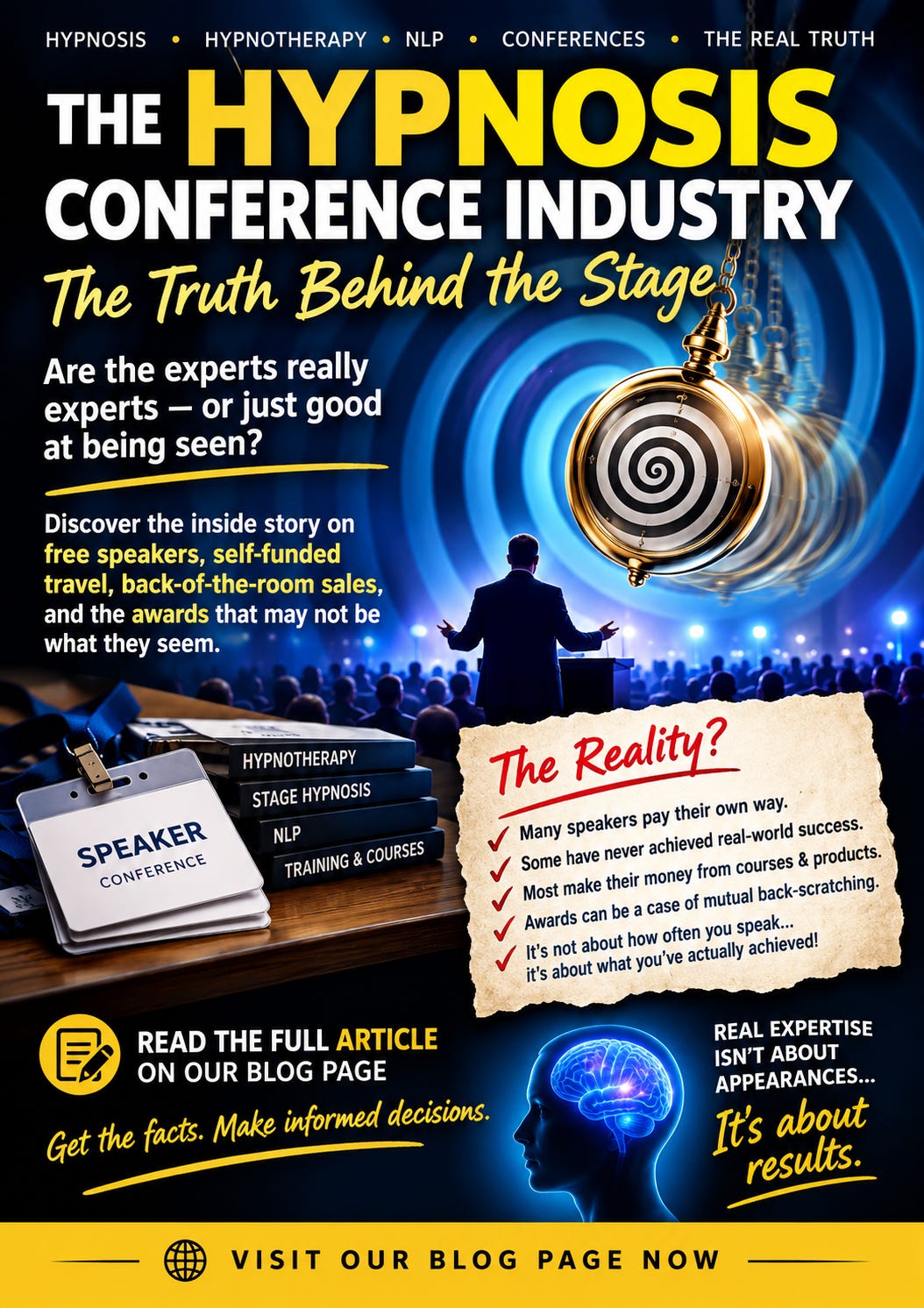
The Hypnosis Conference Industry:
The Truth About Free Speakers, Self-Proclaimed Experts and Mutual Back-Scratching Awards
Are some hypnosis conferences really celebrating expertise, or are they creating an illusion of authority that benefits the people who know how to play the game?
Let me tell you something about the world of hypnotherapy, stage hypnosis, NLP and the many hypnosis and hypnotism conventions and conferences that not everyone in the industry wants to talk about.
Being advertised as a speaker at a hypnosis conference does not necessarily mean you are an expert.
Receiving an award does not automatically mean you are the best in your field.
And being invited onto a conference stage does not necessarily mean you have achieved any great success in the real world.
There. I’ve said it.
Now, before anyone starts choking on their complimentary conference coffee, let me explain.
The Curious Business of Speaking for Free
In my experience, a great many hypnosis conferences and conventions operate on a remarkably convenient arrangement for the event organisers.
The speaker gets a free ticket to attend the event. In return, they provide their time, knowledge, experience and presentation without a speaking fee.
Travel?
Pay for it yourself.
Hotel?
Pay for it yourself.
Food, drinks and all those other little expenses that mysteriously accumulate when you’re away from home?
Your responsibility.
And what do you get in return?
Your name on the conference website, a little publicity, the opportunity to stand in front of an audience of fellow hypnotists and, if you’re lucky, the chance to sell your courses, books, training programmes and other products at the back of the room.
What a deal!
Of course, there are legitimate reasons why an experienced professional might choose to speak without a fee.
Some enjoy sharing knowledge, supporting their profession or meeting colleagues.
Others see a genuine commercial opportunity.
There is nothing inherently wrong with that.
The problem begins when we pretend that this arrangement is something it isn’t.
A free conference ticket is not a speaking fee.
Publicity is not payment.
And the opportunity to sell your products is not the same thing as being professionally remunerated for your expertise.
If a speaker spends hundreds or even thousands of pounds on travel, accommodation, food and other expenses to deliver a presentation, they may actually be paying for the privilege of appearing on that stage.
That is a rather different proposition from being hired as a professional speaker.
The Expert Who Paid to Be There
Here’s where things become particularly interesting.
Imagine a student of hypnosis attending a convention.
They look at the programme and see a long list of speakers, each with a photograph, biography, impressive-sounding title and description of their presentation.
Naturally, the student assumes these people must be successful.
After all, why else would they be speaking at the event?
They see the same names appearing at conventions year after year.
They see photographs of these individuals on conference stages.
They see social media announcements celebrating their latest speaking engagement.
Gradually, an impression forms.
These must be the leading figures in the industry. These must be the people who have built successful practices, developed thriving stage hypnosis businesses or achieved exceptional results in the real world.
But what if the student knew how the arrangement actually worked?
What if they knew that some speakers had paid their own travel expenses, funded their own accommodation and covered their own living costs, all to deliver a presentation without receiving a speaking fee?
Would they view that speaker in quite the same way?
Perhaps. Perhaps not.
The point is that the appearance of professional recognition and the reality of professional success are two entirely different things.
A person can be a regular conference speaker without being a commercially successful hypnotherapist.
Someone can deliver an entertaining presentation without having built a profitable stage hypnosis business.
Another person might be an excellent marketer who has become well known among hypnotists without having demonstrated the achievements their reputation might lead others to assume.
Speaking experience is one thing. Practical achievement is another.
And surely, in a profession that claims to change people’s lives, both deserve to be examined honestly.
Follow the Money: Who Really Benefits?
Now let’s look at the commercial side of the arrangement.
For a conference organiser, unpaid speakers can be extremely attractive.
They help fill the programme, give the event credibility and provide a succession of names that can be used to promote ticket sales.
For the speaker, appearing on that programme can provide visibility, access to a targeted audience and opportunities to sell products or training.
For the audience, the attraction is supposed to be access to valuable knowledge, practical skills and genuine expertise.
In principle, everybody can benefit.
But there is another possibility.
What if a speaker’s principal business is not actually treating clients, performing professionally or running a successful hypnosis practice?
What if their most profitable activity is selling courses and products to other hypnotists and aspiring practitioners?
There is nothing inherently wrong with teaching.
Excellent educators can build highly successful businesses, and a good training course can be enormously valuable.
The question is whether the reputation being used to sell that training accurately reflects the person’s achievements.
If somebody repeatedly appears at conferences, gets photographed on stage, receives flattering introductions and is promoted as a leading authority, that visibility can become a marketing asset in its own right.
Their next course can be promoted using their conference appearances.
Their next conference appearance can be promoted using their previous appearances.
Their growing visibility can then be presented as evidence of their standing in the industry.
And around it goes.
The appearance of authority can become a commercial product, even when the underlying evidence of real-world achievement is difficult to establish.
That is the distinction worth examining.
Not whether someone sells courses.
Not whether someone speaks at conferences.
But whether the reputation used to sell those courses is supported by demonstrable expertise, results and experience.
How Successful Are the Successful?
Here is a question I believe prospective students should ask far more often:
What has this person actually achieved?
Not how many conferences have they attended.
Not how many times have they appeared on a speaker list.
Not how many photographs have they posted of themselves standing beside a lectern.
Not how many certificates, titles or awards appear in their biography.
What have they actually done in the real world?
Have they built a genuinely successful hypnotherapy practice?
Can they demonstrate sustained commercial success?
Have they established a successful stage hypnosis business?
Have they produced meaningful results for clients?
Have they developed methods or teaching that stand up to scrutiny?
And, where someone claims to be a successful businessperson, can they substantiate that claim?
These are reasonable questions, not personal attacks.
Of course, success is not exclusively measured in money.
A practitioner can be exceptionally skilled and valuable to clients without running a large or highly profitable business.
A talented teacher may be motivated by education rather than commercial achievement.
But when somebody uses the suggestion of exceptional professional or commercial success to establish authority, it is reasonable to ask for evidence.
Reputation should invite scrutiny, not exempt someone from it.
The Conference Awards: Recognition or Mutual Admiration?
And then we come to the awards.
Ah, the awards!
Nothing quite adds sparkle to a professional biography like an impressive-sounding trophy or certificate.
A photograph of somebody proudly holding an award can look wonderfully convincing on a website, in a course advertisement or on social media.
But what does the award actually tell us?
Who decided the winner?
What were the judging criteria?
Was there an independent judging panel?
Were nominees assessed against transparent standards?
Were actual achievements examined?
Could someone outside the organisers’ circle realistically win?
These are the questions that matter.
In my view, some awards associated with parts of the hypnosis conference circuit deserve much closer scrutiny.
There is a risk that recognition becomes entangled with attendance, familiarity, friendships and relationships built up over years of appearing at the same events.
Where that happens, awards can start to resemble a mutual admiration society rather than a meaningful assessment of professional excellence.
You scratch my back, I’ll scratch yours.
You support my event, I support yours. You promote my work, I promote yours. We appear on each other’s programmes, congratulate each other on social media and celebrate one another’s achievements.
And before long, everybody seems to be an award-winning expert.
To be clear, an award is not automatically meaningless because its recipient knows the organisers, and not every conference award is compromised. Many awards across many industries are legitimate.
But if an award is intended to tell the public who is genuinely outstanding, its credibility depends on the quality and independence of the process behind it.
A trophy is an object. The process that awards it is what gives it meaning.
Without transparent criteria and credible judging, an award may tell us more about a person’s position within a particular network than about their actual professional ability.
The Speaker Application: Who Is Really Seeking Whom?
There is another aspect of this world that I find particularly revealing.
People actually apply to speak at these events.
They prepare proposals, submit biographies, outline presentations and wait to hear whether they have been selected.
Again, there is nothing inherently wrong with applying to speak. Many excellent conferences operate through an open application process, and being selected can be a perfectly legitimate achievement.
But I have always believed there is a difference between wanting to appear on a conference programme and being sought out because somebody recognises the value of your expertise.
One arrangement begins with the speaker asking for a platform.
The other begins with an organiser recognising that a particular person has something valuable to contribute and making an effort to secure their participation.
Neither arrangement, on its own, proves that someone is good or bad at what they do.
An invitation is not proof of excellence, just as an application is not evidence of incompetence.
The difference becomes more significant when we consider payment, expenses and the overall professional relationship.
Is the organiser genuinely investing in the speaker’s expertise?
Or is the speaker effectively subsidising the event in exchange for exposure?
Is the engagement mutually beneficial?
Or is the speaker being encouraged to regard unpaid work and substantial personal expenditure as an honour in itself?
And if a speaker has to pay their own way to appear, should that appearance really be presented as evidence that they have been professionally recognised?
I think those questions deserve honest answers.
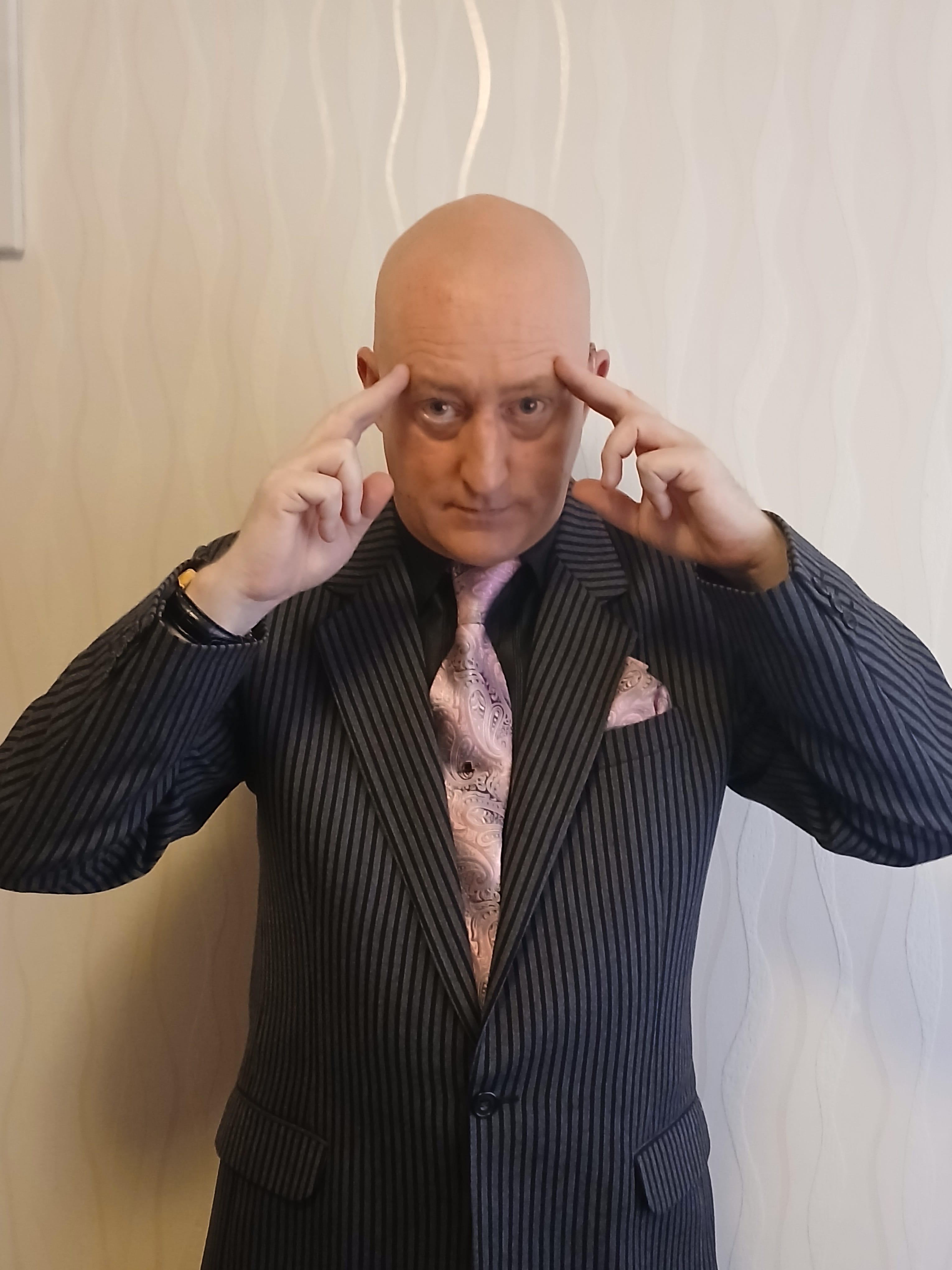
My Own Experience: I Prefer to Be Engaged, Not Just Included
This is one reason I have rarely been particularly interested in speaking at these events.
My approach has always been straightforward.
I speak when I am asked, paid and engaged to!
When I have spoken for people such as Celebrity Hypnotherapist Steve Miller, known for his television work on Fat Families, my experience has been very different.
He has paid my travel and accommodation expenses, allowed me to sell products at the back of the room and, on many occasions, paid me a sizeable speaking fee as well.
That, to me, demonstrates a different approach to engaging a speaker.
The organiser recognises the value of the person’s time, expertise and contribution.
The speaker is not expected to shoulder the financial burden of travelling to an event simply to have the privilege of being included on the programme.
There can still be commercial benefits on both sides. The speaker can sell products, the organiser can deliver a strong event, and the audience can benefit from the presentation.
But there is also a clear recognition that professional expertise has value.
I am not suggesting that every unpaid speaking engagement is wrong, nor that everyone who speaks for free is somehow less credible. People can make perfectly sensible decisions to volunteer their time.
My point is that I prefer a professional engagement in which the organiser recognises my contribution and is prepared to invest in it.
I do not need to collect conference appearances to establish my worth.
Nor do I believe that a long list of speaking engagements is, by itself, proof of professional success.
I would rather be engaged because somebody wants what I can deliver than apply for the opportunity to deliver it for nothing.
The Hidden Cost of Free Speaking
There is also a practical issue that rarely receives much attention.
When speakers fund their own participation, the costs do not disappear. They are simply transferred from the event organiser to the individual.
Consider a speaker who pays for transport, several nights in a hotel, meals and other expenses. Add the time spent preparing the presentation, travelling, attending the event and being away from other professional commitments.
Even if the conference ticket is free, the engagement can carry a substantial financial and opportunity cost.
The speaker may decide that the publicity and potential product sales justify that investment. That is their choice.
But the audience should not automatically interpret the appearance as proof that the speaker has been hired, endorsed or financially rewarded by the organiser.
Those are different things.
There is also a potential problem when repeated exposure creates the impression of a professional hierarchy in which the most visible people must be the most accomplished.
In reality, visibility can be influenced by many factors: marketing ability, personal relationships, willingness to travel, availability, commercial interests and simply the desire to appear.
Some genuinely outstanding practitioners may rarely speak at conferences. Others may be excellent speakers but have little interest in building a business around teaching other hypnotists.
Meanwhile, people who are particularly skilled at self-promotion may become familiar names throughout the conference circuit.
Familiarity is not the same as quality.
And a crowded speaker biography is not the same as a successful career.
What Should Students and Aspiring Hypnotists Look For?
If you are considering spending money on a hypnosis course, attending a convention or choosing somebody to train you, I would encourage you to look beyond the promotional material.
Ask questions.
Look for demonstrable experience. What has the person actually done in the area they claim to teach?
Examine the evidence. Are their claims supported by credible examples, verifiable achievements or meaningful results?
Distinguish teaching from doing. Being an experienced instructor does not automatically mean someone has extensive practical experience in every subject they teach.
Understand the awards. Who issued them, what were the criteria and how were recipients selected?
Question commercial claims. If someone presents themselves as a highly successful practitioner or businessperson, what evidence supports that description?
Evaluate the training itself. Is the content worthwhile, are the methods sound, and does the course offer genuine value for money?
Do not confuse visibility with expertise. A familiar face on the conference circuit is not necessarily the best person from whom to learn.
These questions are not designed to discourage people from attending conferences or learning from other hypnotists.
Quite the opposite.
Good conferences can be valuable. Talented speakers can share knowledge that genuinely improves professional practice. Excellent trainers can help people develop skills they might otherwise take years to acquire.
But the industry benefits when people make informed decisions rather than assuming that a speaker’s position on a programme tells them everything they need to know.
So, What Is the Real Measure of a Professional?
Ultimately, I believe the hypnosis profession needs a more honest conversation about the difference between recognition, visibility, expertise and achievement.
A conference appearance is an appearance.
An award is an award.
A certificate is a certificate.
A successful marketing campaign is a successful marketing campaign.
None of these things, individually, proves that someone is an exceptional hypnotherapist, an accomplished stage hypnotist or a highly successful businessperson.
They may be evidence worth considering, but they are not substitutes for examining the substance behind the claims.
The same principle applies to those of us who choose not to attend every convention, apply for every speaking opportunity or accumulate every available industry accolade.
Not everybody wants to build a business around conference appearances. Not everybody needs to sell courses to other hypnotists. And not everybody considers unpaid speaking engagements an attractive use of their time.
There are different ways to build a career, and there are different ways to contribute to a profession.
For my part, I prefer to let the engagement speak for itself.
If somebody wants me to speak, values what I can contribute and is prepared to engage me professionally, I am happy to have that conversation.
If the proposition is that I should pay my own travel, fund my own accommodation, give my time away and regard a free ticket as sufficient compensation, then it is unlikely to interest me.
That is not arrogance. It is a decision about how I value my time, my experience and my work.
And I would suggest that anybody making a living from their professional expertise should feel perfectly entitled to make the same calculation.
The Bottom Line
The hypnosis conference circuit is not inherently dishonest. Unpaid speaking is not automatically exploitation. Awards are not automatically meaningless. And being a regular conference speaker does not automatically make someone a fraud.
But neither should any of these things be accepted uncritically as proof of excellence.
Where speakers pay their own way, audiences deserve to understand what that arrangement actually means.
Where courses are marketed through claims of authority, prospective students deserve to know what supports those claims.
Where awards are presented as markers of distinction, the judging process deserves to withstand scrutiny.
Above all, we should stop confusing the business of appearing successful with the achievement of being successful.
Because the person with the most conference appearances may not be the person with the greatest practical expertise.
The person holding the most trophies may not be the person delivering the best results.
And the person whose name appears on every speaker list may not necessarily be the person whose professional achievements most deserve your attention.
So the next time you see a hypnosis conference advertising its impressive line-up of experts, award winners and industry authorities, ask yourself one simple question:
Am I looking at a list of genuinely accomplished professionals, or am I looking at a list of people who have become very good at being seen?
There may, of course, be considerable overlap between the two.
But the distinction matters.
Because when it comes to professional credibility, I would rather be asked because I am valued, engaged because I am wanted, and paid because my contribution is worth paying for.
Not simply given a free ticket and told what an honour it is to be there.
I speak when I am asked, paid and engaged to.
And I am perfectly comfortable with that.
After all my Decades of Experience & Success speak for themselves as illustrated within the video and at the various links below…
Also in relation to the ”Awards” many Hypnotherapists claim to have won check out the eye opening video and information available from the link below
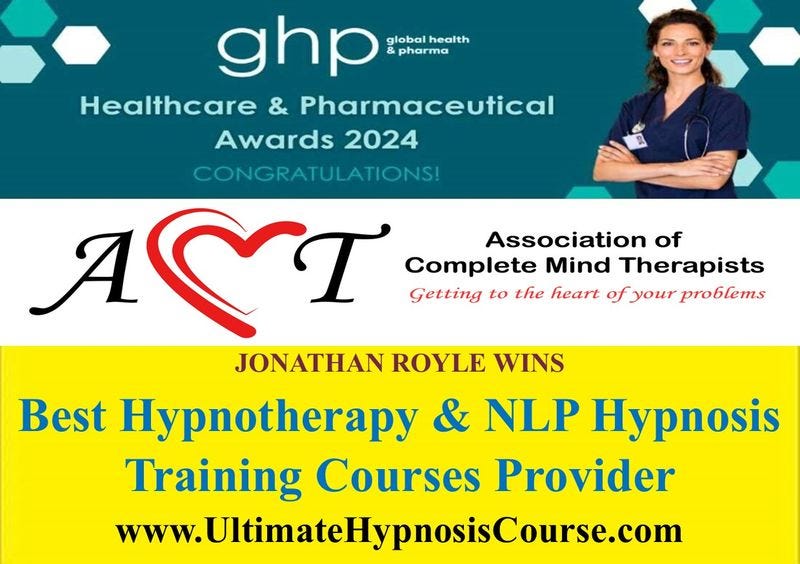
EXPOSED: HOW TO WIN AWARDS
The proof of my Hypnosis Success & Real World Expertise is located at these links
CONFESSIONS OF THE WORLD'S MOST CONTROVERSIAL COMEDY STAGE HYPNOTIST

SOME HIGHLIGHTS OF MY COMEDY STAGE HYPNOSIS SHOWS

WHEN YOU WANT TO LEARN THE TRUE SECRETS OF HYPNOSIS FROM A
GROUP OF EXCEPTIONALLY TALENTED & SUCCESSFUL PEOPLE VISIT
https://www.magicalguru.com/elite-hypnotherapy-nlp-hypnosis-stage-hypnotism-bootcamp/
RESUME FOR MIND MAGICIAN ALEX SMITH aka CELEBRITY HYPNOTIST JONATHAN ROYLE – UPDATED 22nd APRIL 2026

RESUME FOR MIND MAGICIAN ALEX SMITH aka CELEBRITY HYPNOTIST JONATHAN ROYLE – UPDATED 22nd APRIL 2026
From Britain’s Youngest Paid Circus Clown & Variety Entertainer to Child Magical Performer then Europe’s Youngest Professional Psychic Entertainer & Stage Hypnotist - PART ONE

Born Plain Alex William Smith on 13th August 1975 into a Showbiz Family whilst travelling with Gandey’s Circus.
From Britain’s Youngest Paid Circus Clown & Variety Entertainer to Child Magical Performer then Europe’s Youngest Professional Psychic Entertainer & Stage Hypnotist - PART TWO

During the Covid-19 Pandemic when we were all forced to stay at home, in order to pass the time I started my “Hypnosis Week” podcast and as a result have interviewed some of the biggest names in the Stage Hypnosis, Hypnotherapy, Self-Help, Magic, Mentalism & Related Industries.
WHEN YOU WANT TO LEARN THE TRUE SECRETS OF HYPNOSIS FROM A
GROUP OF EXCEPTIONALLY TALENTED & SUCCESSFUL PEOPLE VISIT
https://www.magicalguru.com/elite-hypnotherapy-nlp-hypnosis-stage-hypnotism-bootcamp/
ROYLE HYPNOTIST & MIND MAGICIAN IN PRINT & ON THE BIG SCREEN

USA Today where he had a therapeutic encounter with Robert De Niro and Billy Crystal to help promote the launch of their film Analyse that.
MK-ULTRA EXPOSED = Royle Hypnotist Reveals How People Can Be Hypnotized & Brainwashed to become Assassin's, How Child Sexual Abuse & Trauma Based Mind Control is used to Control People & Events

MK-Ultra: Origins, Objectives, and Lasting Controversy

WHEN YOU WANT TO LEARN THE TRUE SECRETS OF HYPNOSIS FROM A
GROUP OF EXCEPTIONALLY TALENTED & SUCCESSFUL PEOPLE VISIT
https://www.magicalguru.com/elite-hypnotherapy-nlp-hypnosis-stage-hypnotism-bootcamp/
Psychic Secrets Exposed = Examining Manchester Mind Magician & Hypnotist Jonathan Royle's former career as a "Genuine" Clairvoyant

PSYCHIC NEWS PROMOTED ME AS THE “REAL DEAL” IN EARLY 1991
If you found this article interesting be sure to check out some of my other recent expose articles located at the links below
The UK Hypnosis Academy Limited & Hypnotherapist & Hypnotist Karl Smith Exposed as offering “Become a Successful Hypnotherapist” training after entering voluntary liquidation on 12th June 2024

Let’s cut to the chase so to speak, it is a documented fact as recorded in the documents which you can freely access on the Companies House Website here https://find-and-update.company-information.service.gov.uk/company/09600573/filing-history that Karl Smith entered into Voluntary Liquidation of his company
JAMES BRAID EXPOSED = HE DID NOT COIN THE TERMS HYPNOTISM or HYPNOSIS

Unfortunately the vast majority of sources still incorrectly give the false impression that James Braid coined the terms “Hypnosis” and/or “Hypnotism”

STAGE HYPNOTISM - PARTY TRICK OR DEADLY MIND GAME?

In late 1993 after taking part in a Comedy Stage Hypnosis Show presented by Andrew Vincent (who by day was a Post Man and by night a Hypnotist) at The Roebuck Public House in Leyland near Preston some hours later Sharon Tabarn died and as a result her mother Margaret Harper set up CASH = Campaign Against Stage Hypnotists.
DAVID KNIGHT COMEDY STAGE HYPNOTIST & HYPNOTHERAPY TRAINER’S AMAZING CLAIMS PUT UNDER THE MICROSCOPE

https://web.archive.org/web/20201009124411/https://www.davidknighthypnotist.com/page/comedy-show-booking.html
KEVIN LAYE PSY-TAP FOUNDER & HYPNOTHERAPIST EXPOSED

CHECK OUT THIS VIDEO ABOUT KEVIN LAYE FROM ANDREW T. AUSTIN
EXPOSED: Convicted Sex Offender & Hypnotherapist Gary Sutherland’s Hypnotherapy Website Still Active as of today 8th October 2026

RESET HYPNOTHERAPY = GARY SUTHERLAND


JUSTIN TRANZ aka JAMES T. PARKER THE LAS VEGAS STAGE HYPNOTIST - HYPNOTHERAPIST & HYPNOSIS HYPNOTHERAPY TEACHER EXPOSED

HYPNOTIST JUSTIN TRANZ = JAMES T. PARKER EXPOSED