Are EMDR and the Speakmans’ Visual Coding Displacement Therapy Essentially Elaborate Placebo Rituals?
Examining the evidence for expectancy, suggestion, eye movements and therapeutic change
Introduction
Eye Movement Desensitisation and Reprocessing (EMDR), developed by psychologist Francine Shapiro, and the Speakmans’ Visual Coding Displacement Therapy (VCDT), subsequently renamed Visual Schema Displacement Therapy (VSDT), use distinctive procedures intended to reduce the emotional impact of distressing memories.
Although their methods differ, both involve structured mental tasks and unusual instructions concerning the way a person attends to a memory. In EMDR, the individual typically recalls a distressing event while following a moving visual target. In VSDT, the procedure involves a particular sequence of visual attention, memory recall and displacement.
One possible explanation for the benefits reported by people receiving these treatments is that the procedures work primarily through psychological mechanisms such as expectancy, suggestion, attentional redirection, conditioning and the meaning attributed to the therapeutic ritual. On this account, the procedure creates a powerful expectation that a troubling memory can be changed, and that expectation contributes to the experience of relief.
This is a scientifically testable hypothesis. Research on placebo effects, psychotherapy and the individual components of EMDR provides relevant evidence. However, the question is not simply whether these mechanisms can produce change. It is whether they explain all of the therapeutic benefit, or whether particular elements of these treatments also make an independent contribution.
The available evidence supports taking the expectancy hypothesis seriously, but it does not establish that either treatment is nothing more than a placebo.
1. The placebo effect is a genuine psychological phenomenon
The placebo effect is often misunderstood as an imaginary improvement or a patient being fooled into believing that a treatment works. Scientific research presents a more complex picture.
Expectations, learned associations, the treatment environment and the interaction between practitioner and patient can influence subjective experience and symptom reporting. These effects can be psychologically and physiologically real, even when a treatment lacks the specific mechanism claimed for it.
A particularly relevant paper is:
Kirsch, I. (2005). “Placebo Psychotherapy: Synonym or Oxymoron?”
Read the paper in the Journal of Clinical Psychology
Kirsch discusses how expectancy can produce or enhance placebo effects and how expectations also contribute to the outcomes of psychotherapy. This provides a theoretical foundation for examining whether a distinctive therapeutic procedure derives some of its effects from the expectations it creates.
A further useful review is:
Wampold and colleagues (2019). “Placebo Effects in Psychotherapy: A Framework.”
Read the full paper in Frontiers in Psychiatry
The authors discuss contextual influences, shared factors across psychological treatments and the methodological difficulties of separating specific therapeutic effects from the wider treatment experience.
These findings support an important proposition: the setting, rationale, structure and interpersonal context of a psychological intervention may contribute to its effects independently of the specific mechanism proposed by its developers.
However, placebo responses are not identical to placebo effects. Improvement observed after treatment may also reflect spontaneous recovery, regression to the mean, changes in circumstances and other influences. Demonstrating improvement alone therefore cannot establish that a placebo mechanism caused it.
2. Therapeutic ritual, suggestion and the expectation of change
A central part of the hypothesis is that an elaborate therapeutic procedure may communicate importance without relying entirely on verbal persuasion.
Consider a procedure in which a practitioner gives precise instructions, directs a person’s gaze, identifies a particular moment or mental image, and performs a distinctive sequence of actions while explaining that the memory is being changed.
The person may infer several things:
The practitioner possesses a specialised method for changing the memory.
The sequence of actions has a particular psychological purpose.
A noticeable change should occur during or immediately after the procedure.
Any reduction in distress may indicate that the intervention has succeeded.
These are plausible routes through which a treatment could shape expectancy and attention. They do not require the practitioner to make an explicit claim that the process is a placebo.
Research into expectancy effects provides evidence that treatment suggestions can causally influence people’s responses in experimental settings.
For example:
“Expectancy Effects, Failure of Blinding Integrity, and Placebo Response in Trials of Treatments for Psychiatric Disorders.”
Read the review in JAMA Psychiatry
The review discusses experimental evidence that manipulating expectations can change responses to treatments, including effects on emotional experiences.
This is relevant because a convincing treatment rationale and a distinctive procedure could potentially produce expectations of relief. However, the paper does not establish that EMDR or VSDT operates through this mechanism exclusively.
The appropriate conclusion is that expectancy and suggestion are credible candidate mechanisms that should be measured and experimentally controlled when evaluating such interventions.
3. EMDR: does the eye movement itself matter?
EMDR is especially relevant to this debate because researchers have investigated whether its eye movements contribute anything beyond recalling a distressing memory.
The treatment combines several elements, including recalling traumatic experiences, attending to associated emotions and beliefs, therapist guidance, and repeated bilateral stimulation, usually through eye movements.
Consequently, two questions must be distinguished:
Does EMDR as a complete treatment help people with post-traumatic stress disorder (PTSD)?
Does the eye-movement component itself make a meaningful contribution, and if so, through what mechanism?
Evidence about the first question does not automatically settle the second.
A meta-analysis of the eye-movement component
Lee, C. W., and Cuijpers, P. (2013). “A Meta-Analysis of the Contribution of Eye Movements in Processing Emotional Memories.”
This meta-analysis examined 15 clinical studies comparing EMDR with and without eye movements, alongside 11 laboratory studies investigating eye movements during the recall of distressing memories.
The authors reported a moderate effect in clinical studies (Cohen’s d = 0.41) and a larger effect in laboratory studies (d = 0.74), favouring the addition of eye movements.
These findings are important because they challenge the strongest version of the claim that eye movements are entirely inert. In the studies reviewed, adding eye movements was associated with reductions in the emotionality of distressing memories.
But the findings do not establish that eye movements possess a unique, mysterious or trauma-specific therapeutic power. They do not, by themselves, identify the mechanism responsible for the effect.
Possible explanations include competition for working-memory resources, changes in attention, altered memory retrieval, expectancy, or combinations of these processes.
The distinction matters: demonstrating that a component contributes to an outcome is not the same as demonstrating why it contributes.
The working-memory explanation
One influential account proposes that recalling a distressing memory while performing a second demanding task places competing demands on working memory. The memory may consequently become less vivid or emotionally intense.
This explanation is different from the idea that the eyes directly erase or rewrite a traumatic memory. It also differs from the claim that all improvement must be due to placebo.
A useful starting point is the systematic review:
“How Does Eye Movement Desensitization and Reprocessing Therapy Work? A Systematic Review on Suggested Mechanisms of Action.”
The review examines proposed mechanisms of EMDR and the evidence for them. It illustrates that the treatment’s mechanism has been the subject of competing explanations and that a demonstrated clinical outcome does not automatically validate a particular theoretical account.
The working-memory hypothesis therefore provides a serious alternative to a purely expectancy-based explanation, although questions about the precise mechanism and its contribution to clinical outcomes remain.
What does the clinical evidence establish?
The UK’s National Institute for Health and Care Excellence (NICE) recommends offering EMDR to adults with PTSD following non-combat-related trauma occurring more than three months previously, subject to the guidance’s clinical conditions.
Read the NICE PTSD recommendations
This recommendation does not prove a particular neurological explanation for EMDR. Nor does it establish that eye movements are the sole active ingredient.
It does, however, mean that describing EMDR as conclusively demonstrated to be nothing more than a placebo would go beyond the evidence.
A more defensible criticism is that evidence for a treatment’s clinical usefulness and evidence for its proposed mechanism are different questions, and that the latter requires further investigation.
4. The Speakmans’ VCDT/VSDT: what do the studies actually show?
The Speakmans’ technique provides a particularly useful case study because researchers have investigated the effects of its distinctive procedure and compared it with abbreviated EMDR and control conditions.
VCDT is now referred to as Visual Schema Displacement Therapy (VSDT). The distinction in terminology matters when searching the scientific literature.
Laboratory evidence from 2021
Matthijssen, S. J. M. A., Brouwers, T. C., van den Hout, M. A., Klugkist, I. G., and de Jongh, A. (2021). “A Randomized Controlled Dismantling Study of Visual Schema Displacement Therapy (VSDT) vs an Abbreviated EMDR Protocol vs a Non-Active Control Condition in Individuals with Disturbing Memories.”
Read the study in the European Journal of Psychotraumatology
This study involved 144 participants recalling an emotionally aversive event. Participants were assigned to different brief procedures, and researchers measured the emotional disturbance and vividness associated with the memories.
The results indicated that VSDT reduced emotionality relative to the comparison conditions immediately after treatment and at one-week follow-up. At four weeks, VSDT and abbreviated EMDR performed similarly, with both outperforming the control condition on the reported outcomes.
Crucially, the researchers concluded that the mechanism through which VSDT produces its effects remained unclear and that replication in clinical samples was needed.
This finding is relevant to the present argument, but it must be interpreted carefully.
The study does not demonstrate that VSDT works through placebo alone. It demonstrates changes in self-reported memory emotionality and vividness under experimental conditions, while leaving the explanation for those changes unresolved.
Nor does a study involving disturbing memories in a non-clinical sample establish that a treatment can reliably resolve PTSD or other mental health disorders.
Nevertheless, the authors’ conclusion supports an important scientific principle: a treatment may produce measurable effects even when its underlying mechanism has not been established.
Clinical evidence published in 2024
Matthijssen, S. J. M. A., Brouwers, T. C., and de Jongh, A. (2024). “Visual Schema Displacement Therapy versus Eye Movement Desensitization and Reprocessing Therapy versus Waitlist in the Treatment of Post-Traumatic Stress Disorder: Results of a Randomized Clinical Trial.”
Read the full study in Frontiers in Psychiatry
This randomized clinical trial compared VSDT, EMDR and a waitlist condition in people with PTSD.
The authors reported improvements following both active treatments, with VSDT showing promising results. The paper also reports that 58.3% of participants receiving VSDT no longer met PTSD diagnostic criteria at the three-month follow-up.
That figure should not be interpreted as proof that VSDT is a placebo, nor as proof that the treatment’s advertised explanation is correct. It is an outcome reported within a particular trial, and its meaning depends on the study design, sample, comparison groups, follow-up and risk of bias.
Most importantly for the present hypothesis, a trial comparing treatments with a waitlist does not isolate the contributions of expectancy, therapist attention, ritual, memory recall and the specific VSDT procedure.
A waitlist does not provide an equivalent therapeutic experience. Therefore, improvements relative to a waitlist cannot establish which components caused those improvements.
The critical next step would be a well-designed comparison that controls for these factors and directly tests the proposed mechanisms.
5. Why the placebo hypothesis remains plausible—but unproven
The available evidence permits several possible explanations for the effects of EMDR and VSDT.
First, expectancy may contribute to improvement. A person who believes that a procedure will reduce the emotional impact of a memory may experience changes in distress, attention or the interpretation of that memory.
Second, the therapeutic ritual may direct attention away from ordinary rumination and towards a structured task. This may change how the memory is experienced, regardless of whether the procedure’s original explanation is correct.
Third, the act of recalling a distressing memory in a supported setting may itself contribute to change. The treatment may also influence avoidance, emotional processing, beliefs about the memory and the person’s sense of control.
Fourth, specific procedural elements may contribute independently. The evidence on eye movements and working-memory competition means this possibility cannot simply be dismissed.
These explanations are not mutually exclusive. A treatment can benefit from expectancy while also involving cognitive processes that have effects beyond expectancy.
Calling an intervention a placebo does not resolve the scientific question. It identifies one possible class of explanation, but researchers must still establish how much of the outcome it accounts for.
6. What study would test the hypothesis properly?
A strong test would randomly assign participants with comparable distressing memories to carefully matched conditions.
For example, researchers could compare:
Full treatment: the complete EMDR or VSDT procedure.
Matched ritual control: the same duration, practitioner attention, treatment rationale and structured instructions, but without the hypothesised active component.
Expectation-matched control: a credible alternative procedure designed to produce comparable expectations of improvement.
Component comparison: the treatment with and without eye movements or the distinctive displacement sequence.
Researchers would measure treatment expectations before the intervention, the credibility participants attribute to the procedure, immediate emotional responses, memory vividness and distress over time, and clinically meaningful outcomes where appropriate.
They should also measure whether participants believe they received the supposedly active treatment. Otherwise, differences in treatment credibility could complicate interpretation.
The results would help distinguish several possibilities.
If the full procedure consistently outperformed a well-matched control despite equivalent expectations, that would support a contribution from its specific components.
If the full treatment and credible control produced equivalent outcomes, and expectancy explained the observed improvement, that would support the hypothesis that contextual and expectancy effects account for much of the benefit. However, a failure to find a statistically significant difference would not, by itself, prove equivalence; the study would need adequate statistical power and an appropriate equivalence or non-inferiority design.
If both conditions improved but the full treatment performed somewhat better, the most reasonable conclusion might be that common contextual factors and specific procedural effects both contribute.
This kind of research is more informative than attempting to infer the mechanism from dramatic demonstrations, testimonials or improvement following treatment alone.
Conclusion
The proposition that EMDR and the Speakmans’ VCDT/VSDT may derive a substantial part of their effects from expectancy, suggestion, structured ritual and attentional processes is scientifically plausible and worth investigating.
Research establishes that placebo-related mechanisms can influence psychological experiences and that expectations matter in psychotherapy. Studies of VSDT have also reported reductions in the emotionality of disturbing memories while acknowledging that the mechanism remains unclear.
However, the evidence does not prove that either treatment is nothing more than a placebo. In particular, a meta-analysis has found an additional effect associated with eye movements, and clinical research has reported benefits from EMDR and VSDT. Neither finding settles the mechanism, but both must be taken into account.
The strongest evidence-based conclusion is therefore more precise than the original assertion: expectancy, suggestion and therapeutic context are plausible contributors to the effects of EMDR and VSDT, but their relative contributions have not been established well enough to conclude that the treatments operate exclusively through placebo mechanisms.
That conclusion preserves the central scientific criticism—that therapeutic claims should be tested rather than accepted on the strength of ritual, testimonials or explanatory narratives—without claiming that the existing research has proved more than it actually has.
Further scientific reading
These are the most relevant papers for evaluating the argument critically.
Placebo Effects in Psychotherapy: A Framework (2019) — contextual and common factors in psychotherapy.
A Meta-Analysis of the Contribution of Eye Movements in Processing Emotional Memories (2013) — evidence that eye movements may contribute beyond memory recall alone.
A Randomized Controlled Dismantling Study of VSDT (2021) — experimental results and uncertainty about the mechanism of VSDT.
Clinical Trial Comparing VSDT, EMDR and Waitlist (2024) — clinical outcomes and limitations of the available comparison.
How Does EMDR Work? A Systematic Review of Suggested Mechanisms (2018) — competing explanations for EMDR’s effects.
NICE Guidelines for PTSD — the UK clinical guidance on EMDR and other trauma-focused treatments.

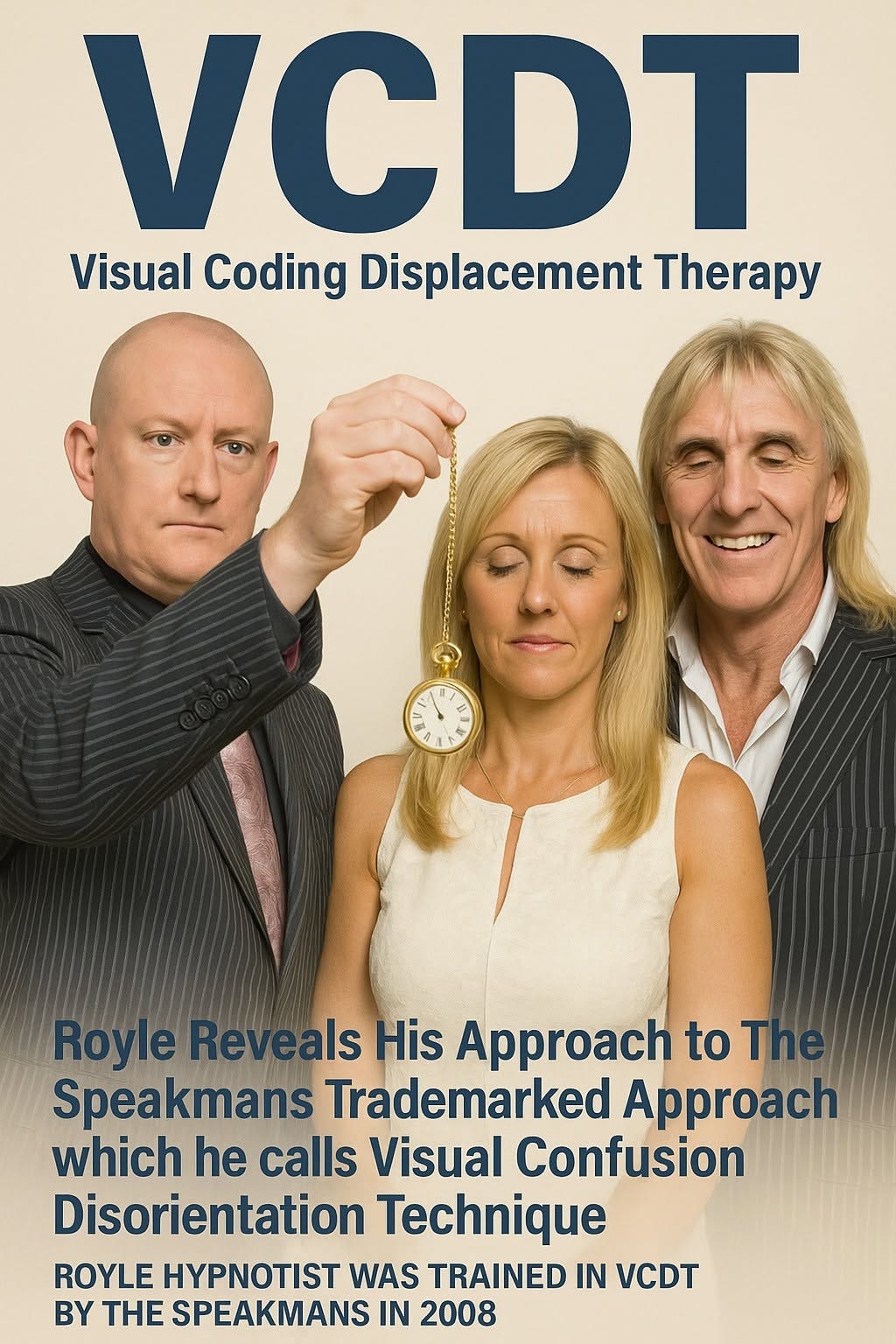
In 2008 I was engaged to do the Public Relations for Nik & Eva Speakman aka UK Celebrity Television & Media Life Coaches “The Speakmans” and as well as obtaining publicity for them I also organised their first two training seminars for fellow Professional Mind Therapy Practitioners.
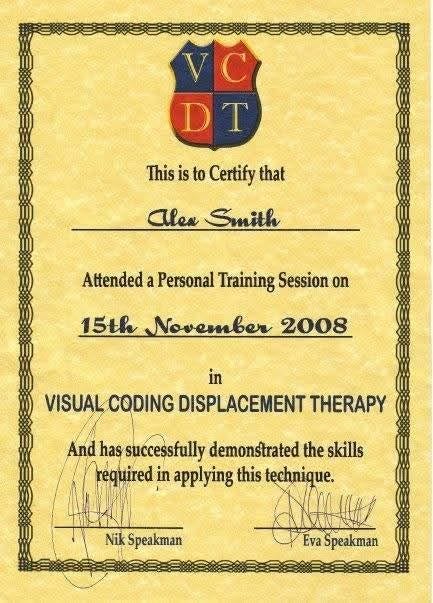
Indeed only a handful of people who were at the 2008 event have ever been awarded a qualification in VCDT = Visual Coding Displacement Therapy.
The second seminar I organised for the Speakmans was filmed and with my help turned into their DVD “You Can Be Cured”

They also officially licensed my “Complete Mind Therapy” treatment System and used a script written by me to produce their “Your Key to Becoming the Best Ever You” Audio Self-Help Compact Disc.

You can learn my “Complete Mind Therapy” One Session treatment approach and gain accredited Certification in the technique with 50% off the normal price by using the discount code WIZARD at checkout here - https://jonathanroyle.sellfy.store/p/h7ad/
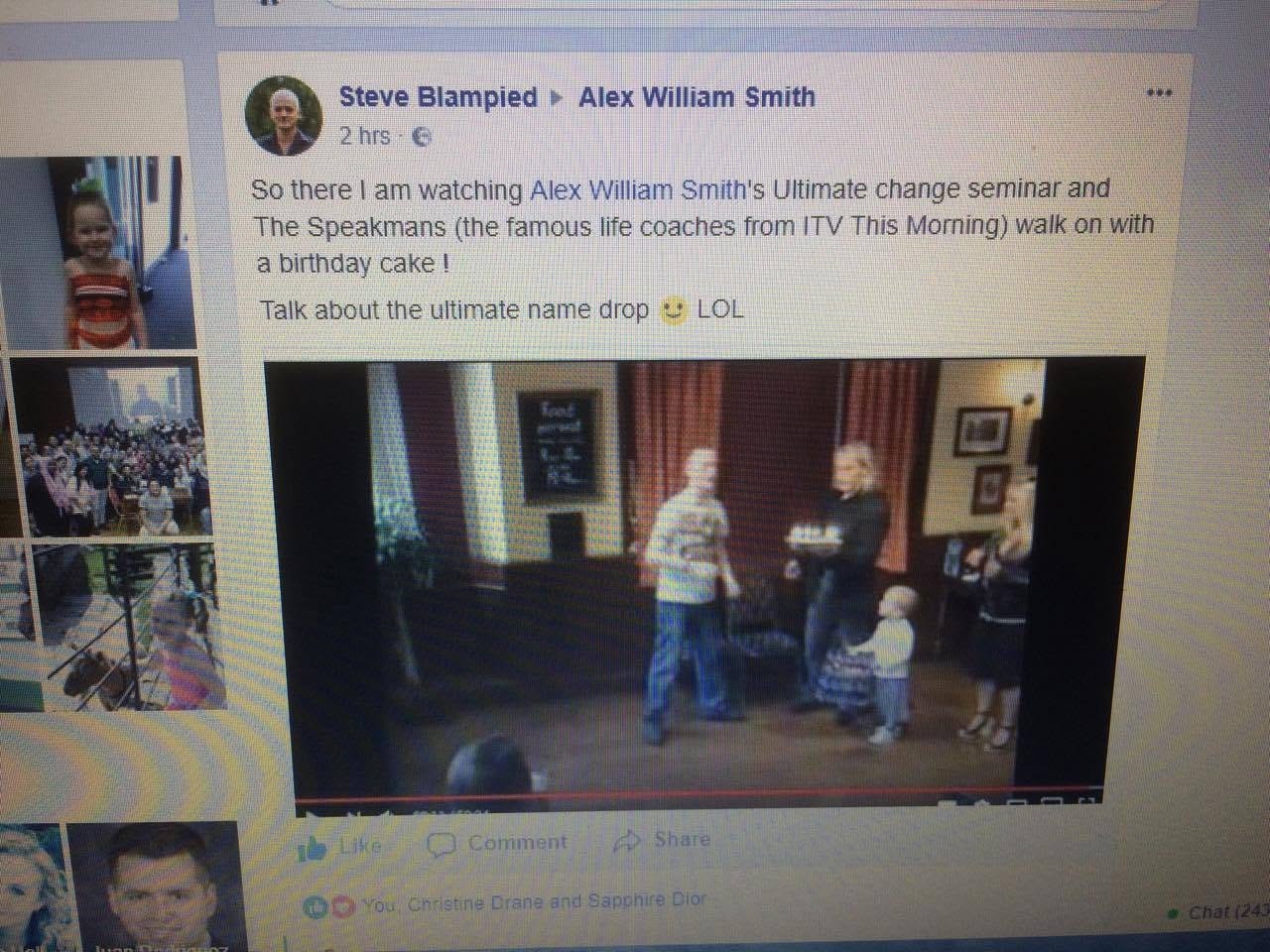
When I did a seminar many years ago in London Nik & Eva Speakman along with their son Hunter showed up to surprise me during the 3 day event with a Cake & presents for my Birthday.
That event was called “The Ultimate Change Seminar” and you can get 80 percent off the usual cost of the videos by using the discount code TRANCER at checkout here https://jonathanroyle.sellfy.store/p/dzph/
Over the years I myself have slightly tweaked VCDT and have now renamed it “Visual Confusion Disorientation Techniques” and I teach it fully in my video training package located here https://jonathanroyle.sellfy.store/p/ii7c/ where again you can use discount code TRANCER to get 80 percent off at checkout.


EFT - Emotional Freedom Technique and TFT - Thought Field Therapy: Do Meridian Tapping Techniques Work, or Are They Just Elaborate Placebo Rituals?

EFT and Thought Field Therapy: Do Meridian Tapping Techniques Work, or Are They Elaborate Placebo Rituals?

EXPOSED: What Did The Late Stage Hypnotists & Hypnotherapists Ormond McGill, Gil Boyne, Tom Silver & Peter Casson all Admit to Jonathan Royle?

EXPOSED: What Did The Late Stage Hypnotists & Hypnotherapists Ormond McGill, Tom Silver, Gil Boyne & Peter Casson all Admit to Jonathan Royle?
EXPOSED: Why Real World Experience & Success combined with Practical Skills and Results Matter Far More Than Hypnotherapy Certificates & Accreditations by Glorified Boys Clubs

After years of hearing & seeing comments from people who frankly should have known better trying to criticise my Hypnosis Courses because they were not and are not accredited by The General Hypnotherapy Standards Council (GHSC) or the General Hypnotherapy Register